Signal Integrity

Breaking the Memory Wall Signal and Power Integrity Challenges of AI Scale-Up.png

Breaking the Memory Wall: Signal and Power Integrity Challenges of AI Scale-Up

The memory wall, once a niche topic for computer architects arguing over cache hierarchies, now shapes how AI data centers are physically built. As large language models move from training into round-the-clock inference, the industry is now pushing against the limits of physics. The problem is how to move enough bytes between memory and logic, and between accelerators, within the loss, noise, power and thermal budgets of copper, optics and power delivery networks.


Read More
Maintain SI at 224 Gbps PAM4 by Moving Beyond Traditional Design Techniques.png

Maintain SI at 224 Gbps PAM4 by Moving Beyond Traditional Design Techniques

As data center systems evolve to support increasingly demanding artificial intelligence (AI) and machine-learning (ML) workloads, maintaining signal integrity at 224 Gbps PAM4 has become a major architectural challenge. One of the primary limitations is insertion loss in conventional PCB traces, which increasingly constrains performance as data rates rise. This paper explores a co-packaged interconnect approach that addresses this limitation by placing the high-speed separable interface directly on the package substrate.


Read More
Fixed PCIe 7.0 at 128 GTs PAM4 .png

PCIe 7.0 at 128 GT/s: PAM4 Validation in Real CEM Channels

PCI Express® is accelerating to meet AI and hyperscale infrastructure demand. PCIe 7.0 reached Base Specification release in June 2025, defining performance at the ASIC pins, and the Peripheral Component Interconnect Special Interest Group (PCI-SIG) Board also announced direction pushing PCIe to 256 GT/s, signaling an accelerated roadmap beyond PCIe 7.0 128 GT/s, and reinforcing a faster standards cadence than prior generations.


Read More
4298 The Role of Precision Timing .png

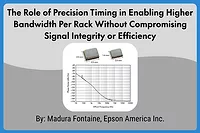
The Role of Precision Timing in Enabling Higher Bandwidth Per Rack Without Compromising Signal Integrity or Efficiency

As requirements for stable, low-jitter clocks grow in hyperscale data centers, so does the complexity of the ubiquitous timing devices. Timing is a foundational requirement for hyperscale data centers and next-generation AI factories. As hyperscalers deploy increasingly powerful GPU clusters to train and serve AI models, stable and low-jitter timing supports high speed interfaces, synchronization mechanisms and reliable data movement across the system.


Read More