As serial data rates continue to increase, signal integrity challenges increasingly resemble traditional mmWave design problems. At frequencies approaching and exceeding 100 GHz, geometry, fabrication tolerance, and electromagnetic detail govern performance. Launch structures, connectors, and transitions often become the dominant contributors to reflection, loss, and channel margin degradation.
To this point, full wave electromagnetic simulations using commercially available solvers such as ANSYS’s HFSS are no longer optional refinements applied late in the design cycle. They become central design tools used to understand, predict, and control high-speed interconnect behavior. However, engineers quickly discover that productivity can drop sharply. Small geometric changes swings, many candidate geometries are not physically realizable, and traditional parametric sweeps can become expensive.
At the same time, artificial intelligence (AI) techniques have begun to be applied in electronic design workflows. For signal integrity applications above 100 GHz, AI does not replace electromagnetic expertise or engineering judgment. When applied carefully and within strict constraints, however, AI can serve as a practical assistant that potentially reduces iteration count, improves convergence reliability, and shortens the path to a manufacturable interconnect solution.
This technical feature describes how AI-assisted methods can be applied within a full wave electromagnetic solver workflow for high-speed interconnect design, with an emphasis on practical connector and launch structures relevant to signal integrity applications.
Where AI Fits in Optimizing High-Speed Interconnects
For high-speed interconnects operating in the mmWave frequencies, unconstrained or freeform AI-generated geometry is neither credible nor useful. Instead, AI provides value when it operates within boundaries defined by known interconnect topologies and fabrication limits.
In practice, AI assistance is most effective in three areas:
- Proposing geometry variations within a fixed, well-understood topology
- Exploring tightly constrained design spaces more efficiently than brute-force sweeps
- Capturing and reusing design results related to geometry and solver setup.
Equally important are the limitations. Current publicly available AI does not reliably identify solver artifacts, cannot determine when a numerically converged result is physically incorrect, and does not account for manufacturing variability. For these reasons, experienced signal integrity engineers must remain firmly in the loop.
Test Case: Coaxial Feedthrough to CPW Launch Transition
The transition from a coaxial feedthrough to a coplanar waveguide (CPW) represents one of the most critical impedance discontinuities in high-speed interconnect design. At frequencies extending into the mmWave region, this transition is often dominated by high return loss and can therefore limit overall channel performance, even when the downstream transmission line is well controlled.
In the structure examined in Figure 1, a UT-020 coaxial feedthrough provides excitation normal to the substrate surface and transitions directly into a ground-backed GCPW. The inner conductor of the coaxial feedthrough is soldered to the CPW center trace, while the outer conductor is tied to the surrounding ground planes through a combination of direct contact and via fencing. This geometry creates an inherently three-dimensional electromagnetic discontinuity in which field symmetry, return-current continuity, and uniform impedance must all be managed simultaneously for efficient propagation.
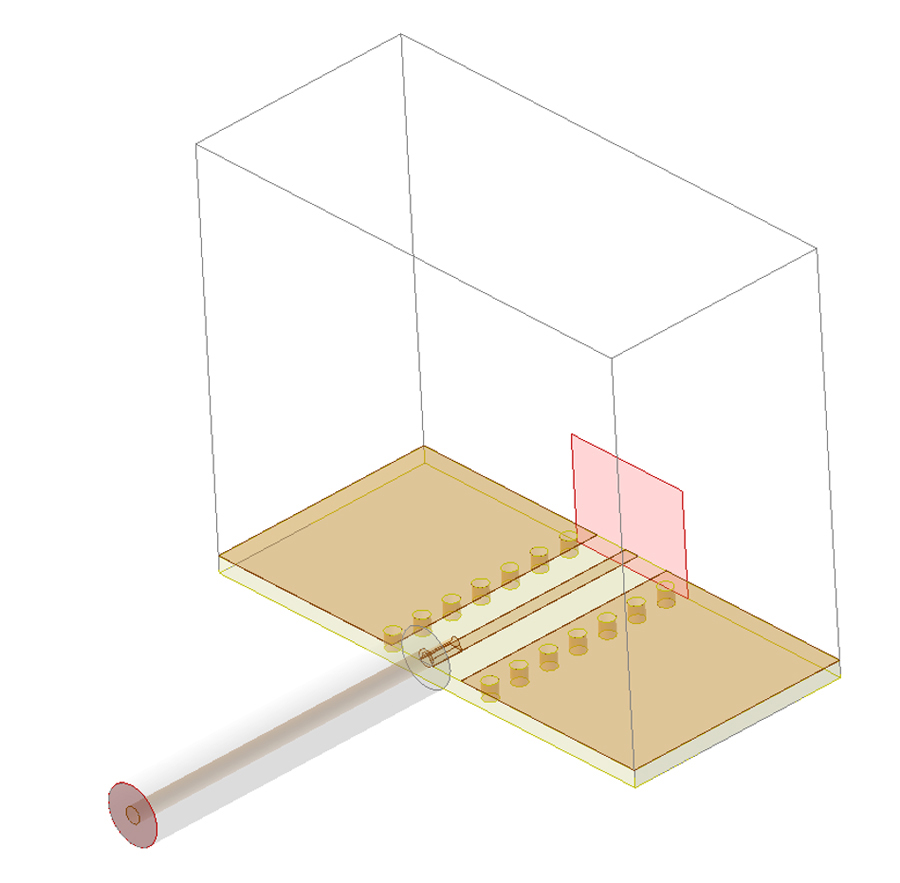
Fig. 1 Simulation test case structure.
For these reasons, the coaxial feedthrough to CPW launch serves as an effective test case for evaluating AI-assisted electromagnetic design workflows. The topology is well-understood, fabrication constraints are well defined, and performance sensitivity is high, making it representative of the types of interconnect challenges encountered in modern high-speed signaling applications.
Parameterizing the Test Case
The UT-020 coaxial feedthrough geometry was held fixed to represent a realistic connector interface while the grounded CPW launch region was fully parameterized to enable controlled investigation of impedance transformation and return-current behavior.
Three geometric parameters were identified as primary contributors to broadband matching behavior and selected for systematic exploration, as shown in Figure 2.
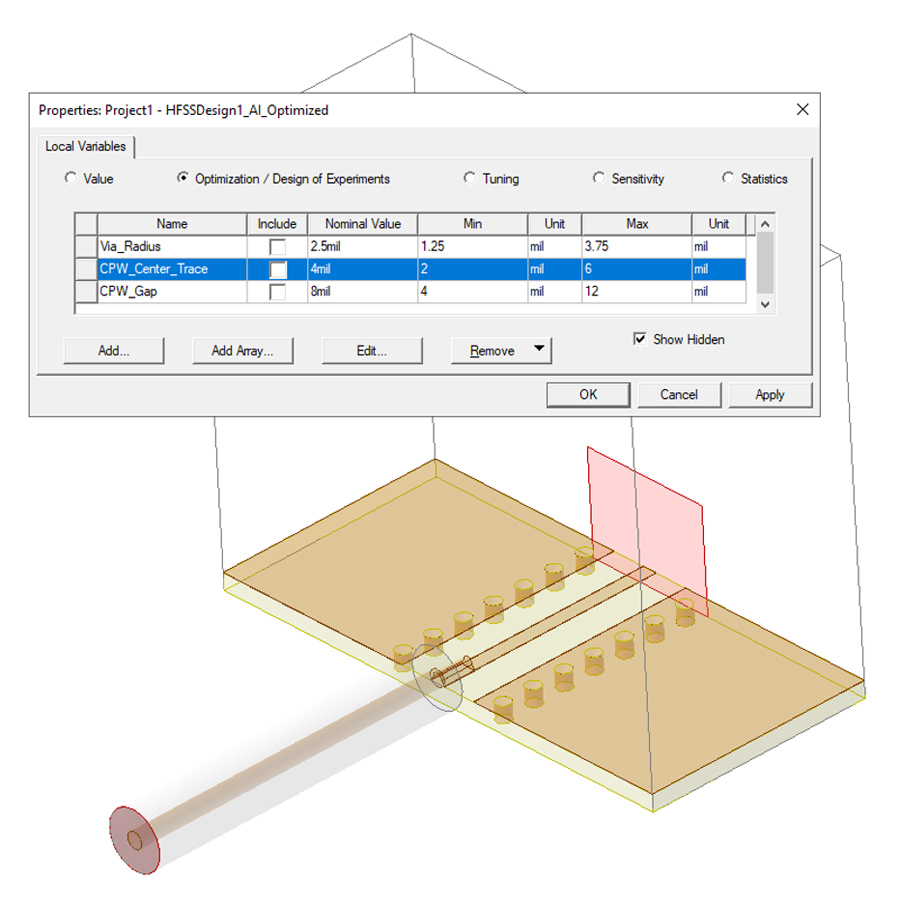
Fig. 2 Parameterized structure to create a dataset for the AI analysis.
1. CPW Center Trace Width
The center conductor width directly influences the characteristic impedance of the CPW, and the capacitive loading presented to the coaxial feedthrough. Small changes in width can significantly alter the local impedance transition at the launch, particularly at the upper end of the frequency band.
2. CPW Ground Spacing (Gap)
The lateral spacing between the center trace and the ground planes affects both impedance and field confinement. At high frequencies, excessive gap spacing can allow return currents to spread, increasing inductance and degrading return loss, while overly narrow gaps can introduce excess capacitance.
3. Ground-Stitch Via Radius
The via radius influences the inductive and resistive properties of the return-current path between the coaxial outer conductor and the CPW ground planes. Larger vias generally reduce inductance and improve high frequency grounding but are constrained by layout density and fabrication rules.
These parameters were swept within fabrication-realistic bounds to generate a discrete set of full wave simulations forming the basis for interpolation and response surface analysis. The overall topology, materials, and excitation method were held constant throughout the study to isolate the effects of geometric variation within the launch region.
This test case provides a challenging but well-understood benchmark for assessing AI-assisted design workflows, as small geometric changes can produce measurable broadband effects while remaining directly relevant to practical signal integrity applications.
AI Analysis Methodology
All parametric simulations were executed in the full wave solver using parametric analysis, with results exported in comma-separated value (.csv) format for post-processing by AI. Separate datasets were generated for each S-parameter (S11, S21, S12, and S22), with each file containing frequency-dependent responses corresponding to a unique combination of geometric parameters. These CSV files served as the sole input to the AI analysis workflow, ensuring that all conclusions were derived directly from actual simulation results.
The first stage of analysis consisted of aligning the individual CSV files by geometric parameters and frequency. Each simulation point was uniquely identified by its CPW center trace width, CPW gap spacing, and ground-stitch via radius. Frequency grids were verified to be consistent across all runs to allow direct comparison and aggregation of results. Only converged simulation data were retained for further analysis.
For each geometry, the worst-case return loss was computed by the AI engine independently for both ports as the least negative value of S11 and S22 across the specified frequency range. A two-port worst-case return loss metric was then defined as the maximum of these two values, ensuring that optimization was not biased toward a single port or a narrow frequency region. Forward transmission parameters (S21 and S12) were evaluated only as secondary checks to confirm that improvements in return loss were not achieved through nonphysical or impractical geometry changes.
The resulting scalar metric provided a single, broadband performance score for each geometric configuration. These scores were then used by the AI tool to construct a continuous response surface as a function of the three swept parameters. A second-order polynomial model, including linear, quadratic, and cross-coupling terms, was determined by the AI tool to fit to the dataset to interpolate behavior within the explored parameter bounds without extrapolation beyond the simulated space.
The interpolated response surface was evaluated by AI on a dense grid spanning the original sweep limits to identify the parameter combination minimizing the two-port worst-case return loss metric. This interpolated optimum represents a predicted best-performing geometry within the explored design space. Importantly, the interpolated result was not treated as final; instead, it was used to guide selection of one or more verification points for subsequent HFSS simulation.
This data-driven reduction and interpolation approach allows systematic extraction of broadband trends from a limited number of full wave simulations while maintaining full reliance on validated electromagnetic results for final design decisions.
Baseline Geometry Selection and AI-Estimated Refinement
An initial baseline geometry was selected by the authors based on conventional signal integrity practice and prior experience with ground-backed CPW launch structures. The baseline dimensions consisted of a 5 mil center trace width, 8 mil gap, and a 2.5 mil ground-stitch via radius. This configuration represents a reasonable starting point for a coaxial-to-GCPW transition, balancing impedance control, manufacturability, and layout density. Importantly, the baseline geometry was not selected to be optimal, but rather to be electrically plausible and fabrication-realistic without detailed tuning.
Using this baseline as a reference, a structured parametric sweep was performed over fabrication-bounded ranges of the center trace width, gap spacing, and ground-stitch via radius, focusing on the 80 to 100 GHz region. These sweep results formed the input dataset for the AI-assisted analysis described previously. The AI tool was not permitted to modify the overall topology, materials, or excitation method; its role was limited to analyzing trends within the discrete parameter space defined by the parameter sweep data.
Based on interpolation of the sweep results and evaluation of broadband return loss metrics, the AI-assisted analysis identified an estimated optimum geometry of approximately 4.5 mil center trace width, 10 mil gap, and 2.28 mil ground-stitch via radius, as shown in Figure 3.
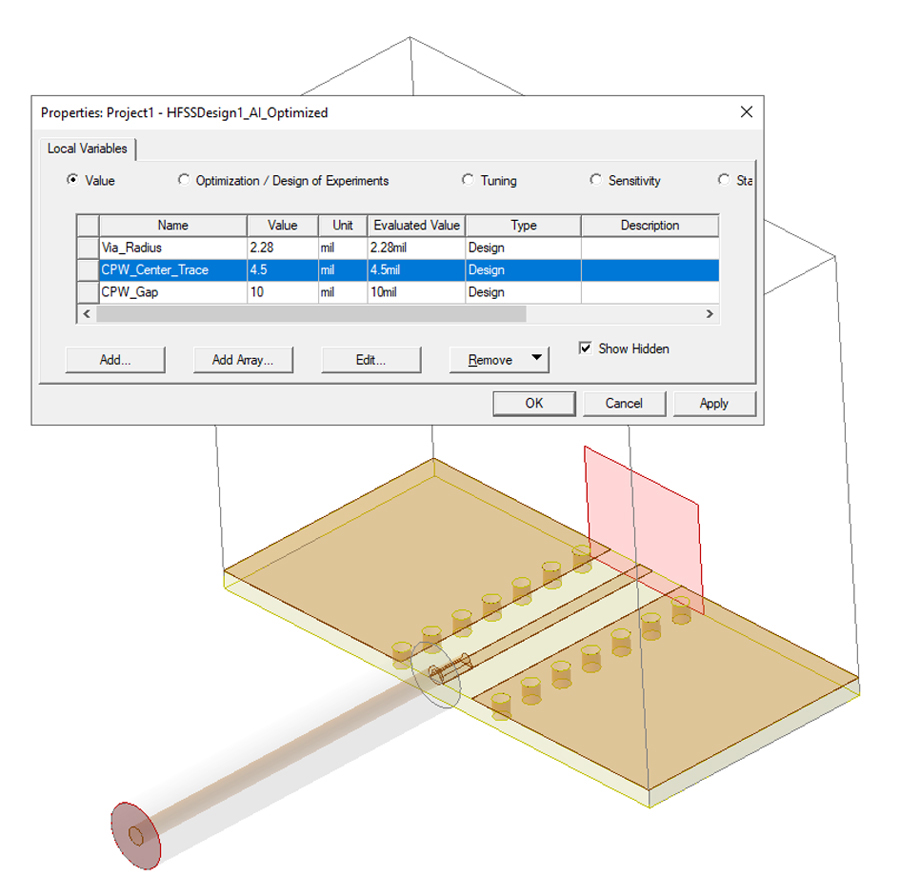
Fig. 3 The structure re-simulated with the AI optimized parameters.
This geometry differs from the original baseline in two important ways. First, the wider CPW gap reduces capacitive loading and improves broadband field confinement near the launch region. Second, the reduced center trace width compensates for this increased spacing to maintain a favorable impedance transition. The slightly smaller via radius reflects a balance between return-current inductance and local parasitic capacitance within the explored parameter bounds.
Notably, the AI-estimated geometry lies within the parameter ranges explicitly provided by the parametric sweep data and does not introduce non-manufacturable features or extrapolated dimensions. The result represents a refinement derived from the available simulation data rather than a freeform or unconstrained design suggestion. This comparison highlights how AI-assisted analysis can guide designers away from reasonable but non-optimal initial guesses toward improved broadband performance using information already embedded in a limited set of full wave simulations.
Comparison of Baseline and AI-Estimated Launch Performance
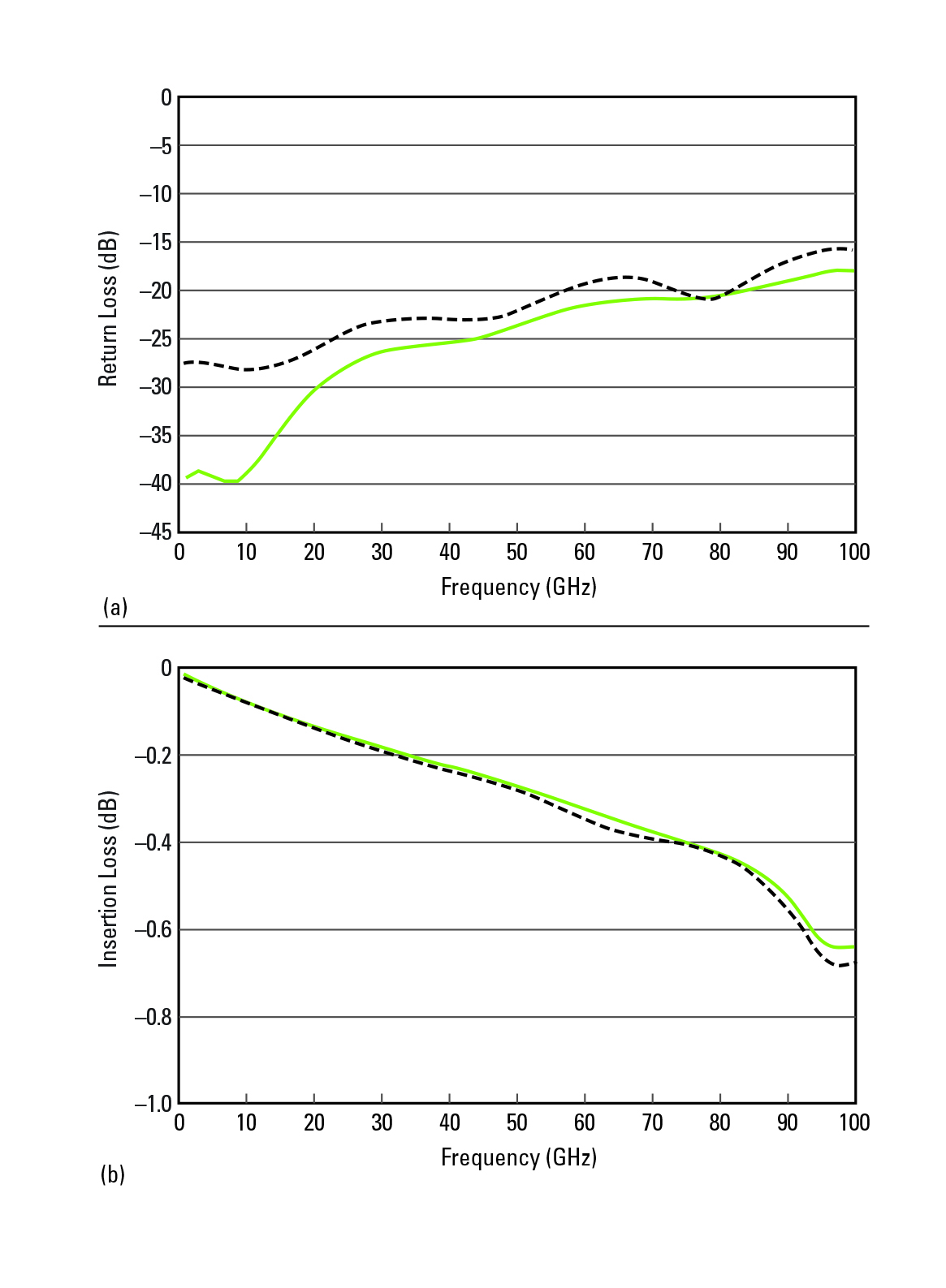
Figure 4 compares the simulated performance of the initial baseline launch geometry and the AI-estimated geometry derived from interpolation of the parametric sweep data. The baseline design (5 mil center trace width, 8 mil gap, 2.5 mil ground-stitch via radius) is shown in dashed black, while the AI-estimated geometry (4.5 mil center trace width, 10 mil gap, 2.28 mil ground-stitch via radius) is shown in green.
Fig. 4 Comparison of return loss (a) and insertion loss (b) between baseline geometry (black dashed curve) vs. AI-assisted geometry (green curve).
Figure 4a shows the broadband return loss of the launch structure from 1 to 100 GHz. Across the entire band, the AI-estimated geometry exhibits a consistent improvement in return loss relative to the initial guess. The improvement is most pronounced at lower and midband frequencies, where the baseline design shows elevated reflection levels, but it remains evident through the upper end of the band. Importantly, the AI-estimated result does not rely on a narrowband resonance or localized notch; instead, the improvement is smooth and broadband in nature, indicating a more balanced impedance transition through the launch region.
Figure 4b shows the corresponding insertion loss comparison. The two designs track closely across most of the band, indicating that the improved matching achieved by the AI-estimated geometry is not the result of excessive conductor widening or nonphysical impedance distortion. At the highest frequencies, the AI-estimated geometry shows slightly reduced insertion loss relative to the baseline, consistent with improved field confinement and reduced parasitic effects in the launch region.
These results demonstrate that the AI-assisted interpolation approach led to a geometry that improves broadband matching without introducing penalties in forward transmission. From a signal integrity perspective, this represents a more robust and predictable launch transition, achieved through the refinement of physically meaningful geometric parameters rather than changes to topology or materials.
Conclusion
Based on the results of this study, the primary benefit of the AI-assisted workflow was not a drastic reduction in the time required to identify an acceptable launch geometry. A reasonable design target could have been achieved through conventional manual tuning within a comparable number of full wave simulations. However, manual processes can leave the hardware designer blind to the broader parametric landscape, offering little insight into whether a solution is near-optimal or if significant improvements remain unexplored.
In contrast, the AI-assisted approach enabled a systematic exploration of the design space, identifying an interpolated optimum that eludes intuitive manual adjustment. By analyzing trends across the full dataset rather than focusing on isolated tuning steps, the method revealed a geometry that delivered improved broadband performance while remaining consistent with fabrication constraints.
From a signal integrity perspective, the value of this approach lies in mitigating uncertainty rather than increasing raw design speed. However, this path is not without its own model uncertainties. The “optimum” parametric values identified by the AI tool are inherently tied to the specific algorithm and training data used; other mathematical techniques or specialized models may exist that could converge on similar or superior results more efficiently. Furthermore, there remains the risk that an AI-optimized solution may be an artifact of the mathematical model’s interpolations rather than a reflection of physical reality.
As operating frequencies increase and interconnects become more sensitive to minute geometric details, the ability to identify robust optima — rather than simply satisfactory — designs will become increasingly critical. While commercially available full wave solver tools will likely incorporate specialized AI, the engineer must still weigh the trade-offs: Whether the marginal gains in performance justify the additional compute resources and time.