The Challenge: Measurement Uncertainty Obscures VRM Performance Gains
Measuring power rail transient performance in response to high current dynamic loading is essential for power integrity validation. Modern AI GPU boards can experience dynamic currents exceeding 1000 Amps (A), creating demanding validation requirements. However, these evaluations have revealed that these critical power rail measurements vary wildly based on measurement location and equipment used, creating uncertainty that obscures validation of potential gains from next-generation Voltage Regulator Module (VRM) designs and can lead to incorrect engineering decisions.
In this article, power rail voltage measurement uncertainty is examined using several different probe configurations to monitor VCore measurements on a Picotest S2000 load stepper board. The results reveal measurement variations up to 27 mV — a level of uncertainty that can completely mask the performance improvements engineers are seeking from advanced VRM technologies.
How can engineers trust their measurements when the uncertainty exceeds the performance gains they are trying to validate?
TLVR Technology’s 10 mV Promise
Recent research presented at DesignCon 2025 by Idan Ben Ezra of Broadcom, along with Steve Sandler, Heidi Barnes, and Benjamin Dannan, demonstrated the potential of Trans-inductor Voltage Regulator (TLVR) technology, a specialized type of VRM that enhances the transient response of power delivery systems, particularly for high-current, low-voltage applications Transformer-Less Voltage Regulator.1 Their simulation results showed that TLVR VRMs with non-linear control could improve transient response significantly by approximately 10 mV compared to traditional VRM designs as shown in Figure 1.
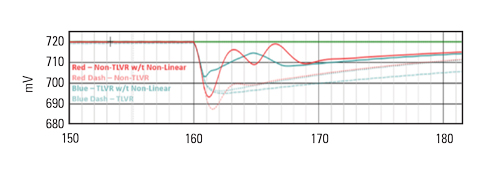 Figure 1. Simulation results showed that TLVR VRMs with non-linear control could improve transient response significantly by approximately 10 mV compared to traditional VRM designs.1Source: Idan Ben Ezra, Broadcom.
In measurement this might not be as clear, but what are the ramifications of TLVR VRMs? The TLVR VRM requires a 2-winding inductor rather than a single-winding inductor. The secondary inductor windings from each VRM phase are series connected. If the series connection opens, the benefit is lost. Many applications monitor this winding loop and shut down the board if a connection is lost. In the case of a 16-module VRM, 32 switching phases are generally included, so 32 additional windings and one of the 32 connections opening can result in the board being disabled.
The impacts are summarized as:
Added complexity: TLVR requires dual-winding inductors instead of single-winding designs
Increased cost: Additional windings and monitoring circuitry
Reliability concerns: In a 16-module VRM with 32 switching phases, any of the 32 secondary winding connections could disable the entire board
Space constraints: Extra inductor windings consume valuable PCB real estate.
The engineering decision to adopt TLVR technology hinges on reliably measuring this 10 mV improvement. Yet measurement uncertainty of 27 mV — nearly three times the expected gain — makes this validation impossible with conventional measurement approaches.
Experimental Setup
All of the measurements were performed on a Picotest 2000 A demo board as shown in Figure 2. This system uses a matrix of 256 individual GaN load cells that emulate the dynamic 2000 A, sub-nanosecond transients that today’s VRM designs must withstand. A 16-bit high-speed microcontroller provides 11-bit load control (up to 2047 A with 1 A resolution) at sample rates exceeding 50 MSPS. A single probe test pad was used for the voltage monitoring; a single channel of a single oscilloscope was used for the testing to eliminate oscilloscope termination and setting variations from the results; and a pre-programmed demo transient pattern was used to create an identical dynamic load transient for each evaluation.
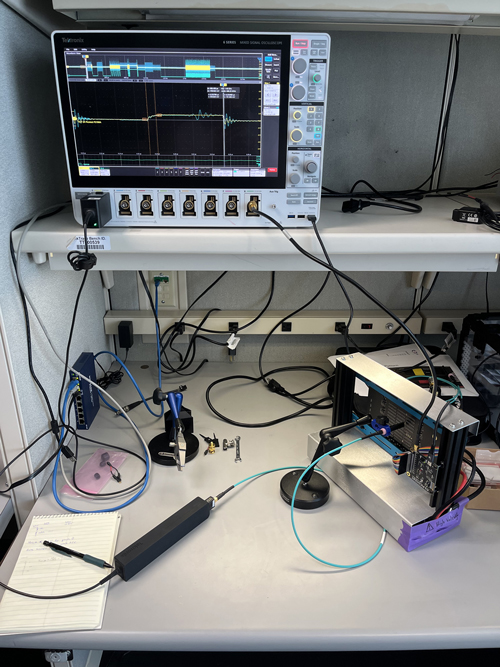 Figure 2. Experimental test setup.
The comprehensive load pattern stresses all aspects of power rail design by including:
Fast current steps and bursts with nanosecond edges
Linear and exponential current ramps
Sine wave patterns at various frequencies
Gaussian noise patterns
Current steps of varying amplitudes.
This pattern exposes non-linear, time-variant, and large-signal effects that traditional impedance measurements and Bode plot analysis cannot reveal.
Probe Configurations
Seven different Tektronix and Picotest probe configurations were evaluated to quantify measurement uncertainty (see Figure 3):
TICP with J2115A isolator (P2104A 2X tip) - 25 acquisitions
TICP without isolator (P2104A 2X tip) - 15 acquisitions
TICP with 10X tip (baseline comparison) - 25 acquisitions
TPR with J2115A isolator (P2104A 1X tip) - 20 acquisitions
TPR without isolator (P2104A 1X tip) - 21 acquisitions
BNC with J2115A isolator (P2104A 1X tip) - 20 acquisitions
BNC without isolator (P2104A 1X tip) - 20 acquisitions
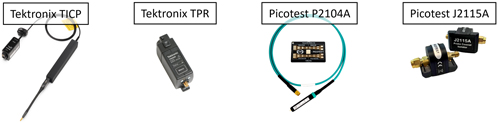 Figure 3. Examples of probe configurations tested.
These configurations test the effects of isolation from both galvanically isolated TICP probes and transformer-coupled isolation via the J2115A. TICP provides differential measurements with DC-to-DC galvanic isolation, while the J2115A offers isolation above 1 kHz. In addition, TPR and BNC measurements are ground-referenced, making them more susceptible to ground loop errors.
Measurement Protocol
For each probe configuration, multiple acquisitions were performed (15-25 samples) to enable statistical analysis. All VCore voltage measurements, (see Figure 4) were taken during identical load patterns on the same test pad to ensure fair comparison.
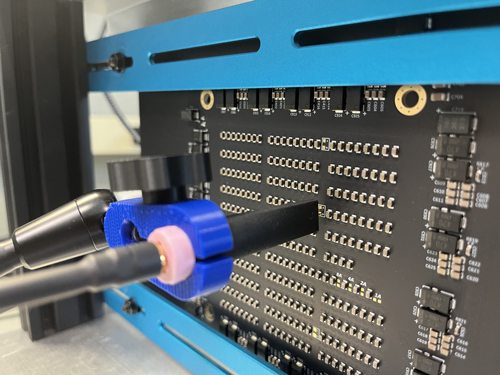 Figure 4. VCore test point location.
Statistical Analysis Approach:
Mean, maximum, and minimum voltage values recorded for each acquisition
Standard deviation calculated across multiple acquisitions
Normalization using Mean VCore voltage (843.02 mV) for consistent comparison
Uncertainty quantified as the range between maximum and minimum values.
Key Measurements:
Mean voltage stability: baseline voltage consistency
Maximum voltage deviation: peak voltage during load transients
Minimum voltage deviation: voltage droop during load steps
Standard deviation: measurement repeatability across acquisitions.
The Root Cause: Ground Loop Error and Probe Noise
The measurement results (see Figures 5 and 6) revealed two critical factors affecting measurement quality: ground loop error and probe noise.
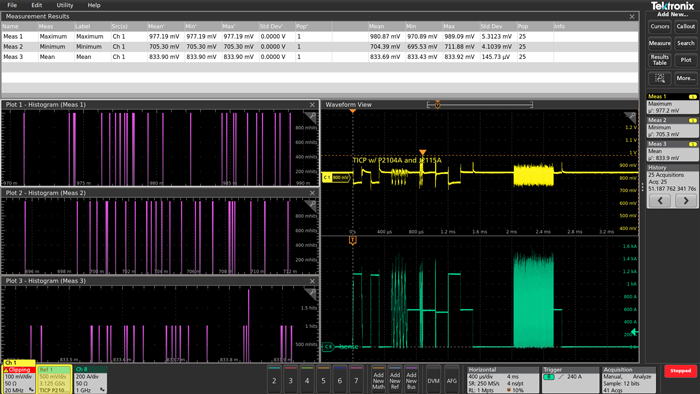 Figure 5. VCore measurement statistics for one probe configuration.
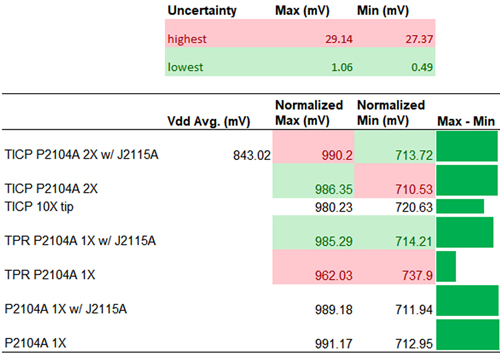 Figure 6. VCore measurement results.
Ground Loop Error: The Primary Culprit
The measured data provides compelling evidence that ground loop error is the primary source of measurement uncertainty. While measurements varied significantly across configurations, solutions incorporating the J2115A coaxial isolator showed much closer agreement. TICP probe results were similar with and without the J2115A isolator, confirming that the large variance stems from ground loop error.
Ground loop error occurs when multiple ground paths create circulating currents that induce voltage errors in measurements. The J2115A coaxial isolator corrects this error at frequencies between approximately 1 kHz and 10 MHz. Above 10 MHz, coaxial probe cables often provide sufficient ground loop isolation on their own.
Probe Noise: The Secondary Factor
Probe noise also significantly impacts measurement accuracy. When a 10X attenuating tip to the TICP probe was attached, the results varied dramatically, demonstrating how probe noise can sway measurements. This highlights why simply using a differential probe like a Tektronix TDP1500 is not always the solution — high-impedance differential probes are particularly susceptible to noise pickup, and many differential probes introduce their own noise.
Measurement Recommendations
Based on the findings, a multi-layered approach to minimize measurement uncertainty is recommended:
-
Isolation is Essential
TICP probes provide galvanic isolation down to DC, eliminating ground loops
J2115A coaxial isolator offers transformer-coupled isolation above 1 kHz
Combined approach: While TICP’s high CMRR provides significant isolation, adding the J2115A isolator provides additional protection without degradation.
-
Low-Noise Probe Selection
Low-impedance probes reduce susceptibility to noise pickup
High shield attenuation cables minimize electromagnetic interference
Short probe pins reduce antenna effects
Ferrite-shielded probe tips block high-frequency noise.
-
Best Practices for Power Rail Measurements
Use differential probes, when possible, but ensure they have low noise characteristics
Implement coaxial isolation for ground-referenced measurements
Minimize probe lead length to reduce inductance and noise pickup
Verify measurements by shorting probes on a ground pad — TICP should show minimal difference with and without isolator, while TPR and P2104A/5A should show significant improvement with isolator.
Conclusions
The investigation reveals that measurement uncertainty in power rail validation stems primarily from ground loop error and probe noise. With measurement variations up to 27 mV — nearly three times the 10 mV improvement promised by TLVR technology — conventional measurement approaches cannot reliably validate next-generation VRM performance.
The solution requires a comprehensive approach:
Galvanic isolation through TICP probes eliminates ground loops down to DC
Coaxial isolation via J2115A isolators provides additional protection above 1 kHz
Low-noise probe design with high shield attenuation and ferrite protection
Proper measurement practices including short probe leads and ground pad validation.
While Picotest PDN cables provide higher shield attenuation than most and the Tektronix TICP probe offers much higher CMRR than conventional probes, neither provides infinite protection. Engineers must implement all available error minimization techniques to achieve the measurement certainty required for confident decisions.
The bottom line: Do not let measurement error exceed VRM performance gains. With proper probe selection and isolation techniques, engineers can achieve the measurement accuracy needed to validate the 10 mV improvements promised by next-generation VRM technologies.
Next Steps: Advanced Validation Techniques
Future work will explore additional validation techniques, including:
Additional probe trials with Tektronix TDP1500 and Picotest P2105A browsers
Better normalization techniques to add in offset gain and gain compensation to the existing offset normalization used in this article
Ground to ground measurement and shorted ground measurements to quantify the ground bounce
Frequency-domain analysis of measurement uncertainty.
By addressing measurement uncertainty at its source, engineers can move beyond “blindfolded engineering” and make confident decisions about power integrity optimization.
Reference
1. S. Sandler, B. Dannan, H. Barnes, and I. B. Ezra. “Power Delivery Network Master Class on 2000A: How to Design, Simulate, & Validate,” DesignCon 2025.