Introduction
The rapid growth in data centers, AI, and supercomputing demands significantly faster edge rates at the package and PCB levels, necessitating superior power delivery network (PDN) measurement solutions. As currents increase and voltage rails shrink, managing fluctuations becomes a critical challenge. Issues such as jitter, frequency-dependent loss, and crosstalk can lead to significant voltage sags and ground bounce. These disturbances directly impact signal integrity through power supply-induced jitter and amplitude noise. Consequently, high-fidelity PDN analysis is now an essential phase of the digital design process.
The Benchmark: Identifying Measurement Uncertainty
A recent study published in Signal Integrity Journal investigated measurement uncertainty using a Tektronix MSO6 and a Picotest 2000 A Transient Load Slammer.1 The study revealed a measurement variation of 27 mVpp across seven different probe combinations. The findings identified probe noise and ground loop error as the primary culprits behind this variance.
To further validate these findings and explore the need for high Common Mode Rejection Ratio (CMRR) solutions, the experiment was replicated using the Rohde & Schwarz MXO5 platform while utilizing the same 2000 A Picotest Transient Load Slammer. The goal was to determine if similar measurement deltas occur across different high-performance hardware when subjected to extreme current transients. This allowed for validation that this error is truly vendor and oscilloscope agnostic; ground loop artifacts and probe noise are universal physical challenges that persist across high-performance hardware unless specific mitigation strategies are employed.
The Stimulus: High-Current Transient Load Testing
To ensure the PDN was sufficiently stressed, the Picotest 2000 A Transient Load Stepper was utilized. This system uses a matrix of 256 individual GaN load cells to emulate the dynamic 2000 A, sub-nanosecond transients that modern VRM designs must withstand. A 16-bit high-speed microcontroller provides 11-bit load control (up to 2047 A with 1 A resolution) at sample rates exceeding 50 MSPS.
Comprehensive Load Pattern Analysis
The experiment used a comprehensive load pattern similar to that of the first experiment,1 designed to stress all aspects of power rail design. This specific pattern is critical because it exposes non-linear, time-variant, and large-signal effects that traditional impedance measurements and Bode plot analysis cannot reveal. The pattern includes:
- Fast Current Steps and Bursts: Utilizing nanosecond edges to test high-frequency decoupling.
- Linear and Exponential Ramps: To evaluate the control loop response of the VRM.
- Sine Wave Patterns: Swept at various frequencies to identify PDN resonances.
- Gaussian Noise: To emulate the stochastic nature of actual processor workloads.
- Variable Amplitudes: To ensure stability across the entire operating range of the regulator.
Measurement Setup
The experiment utilized an R&S MXO58 with six distinct probing configurations. Channel 1 captured emulated current from the Picotest Load Stepper, while Channel 3 measured voltage via a P2105A probe on the PCB PDN. All voltage measurements were set to 50 Ω termination with a 50 MHz bandwidth to maintain consistency across 100 acquisitions.
Experimental Results
The results confirm that as the isolation and CMRR of the measurement chain increase, the observed peak-to-peak noise significantly decreases. For a high-CMRR measurement solution, the R&S RT-ZISO isolated probing system was utilized as a core component of this experiment. Specifically, the Z101 probe tip was selected to provide the necessary interface for the PDN measurement points.
The RT-ZISO system is engineered to maintain high common-mode rejection even at elevated frequencies, which is essential when probing near high-speed GaN switching transients. Figure 2 shows RT-ZISO’s measured CMRR response across its various probe tip solutions, highlighting the superior performance of the Z101 in high-current environments.
The quantitative impact of this isolation is summarized in Table 1, showing a clear correlation between increased CMRR and reduced measurement artifacts.
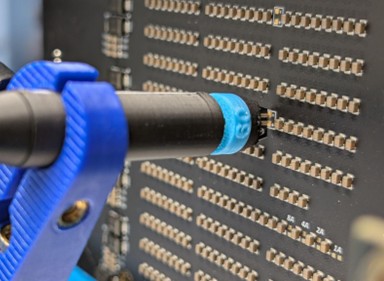 Figure 1. P2105A probe measurement location on Picotest 2000 A Transient Load Stepper.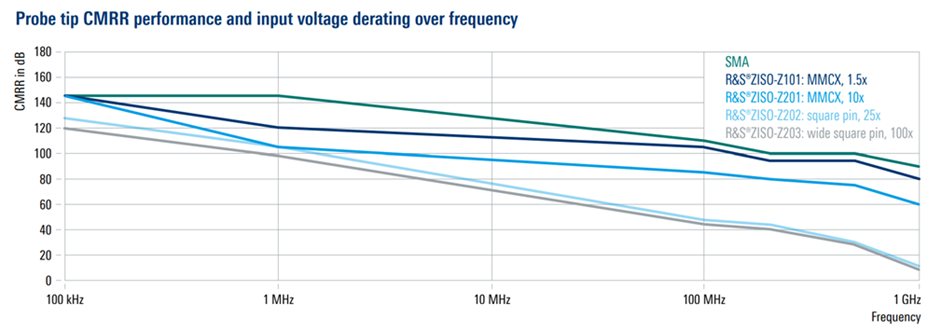
Figure 2. CMRR graph of RT-ZISO.
Summary of Results
The results are summarized in Figures 3 through 8 and in Table 1 below for each measurement. Additionally, Figures 3 through 8 show the measurement configuration.
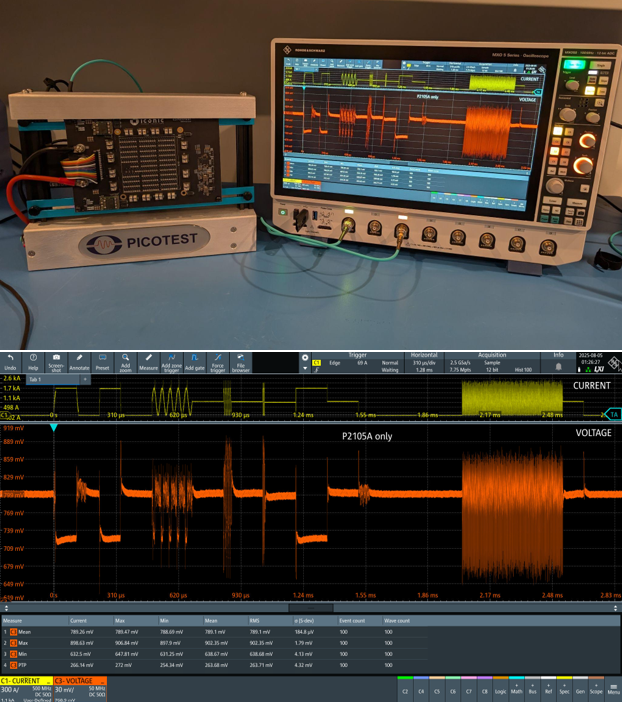
Figure 3. Measurement setup and result with R&S MXO5 and Picotest P2105A.
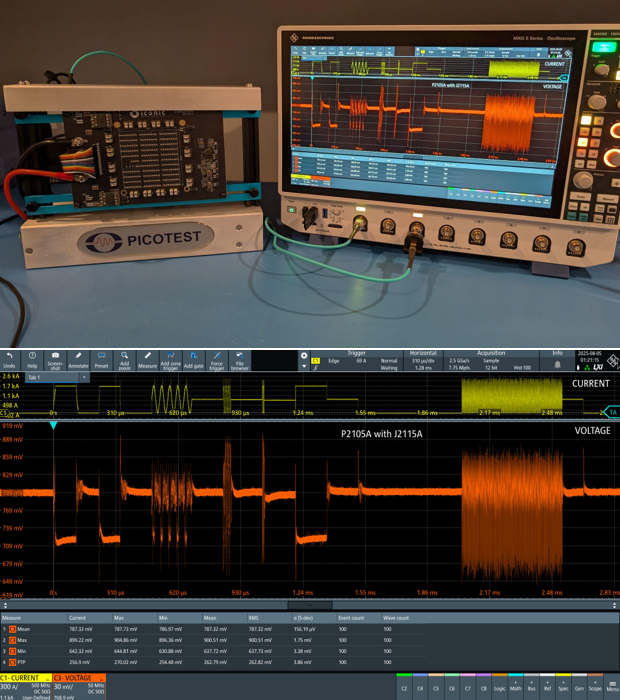 Figure 4. Measurement setup and result with R&S MXO5 with Picotest P2105A and J2115A.
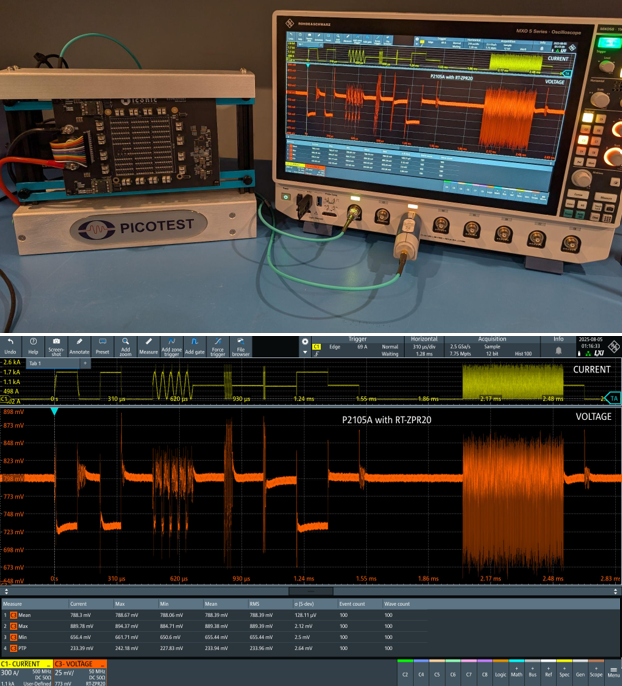 Figure 5. Measurement setup and result with R&S MXO5 with RT-ZPR20 and Picotest P2105A .
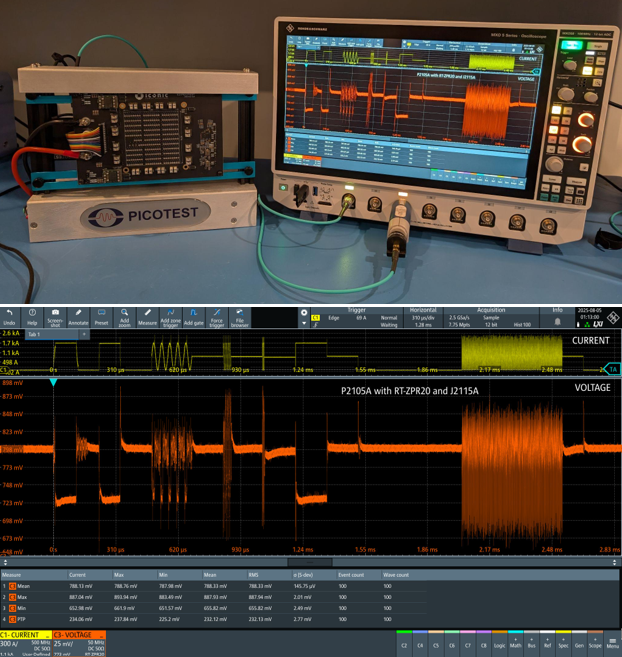 Figure 6. Measurement setup and result with R&S MXO5 with RT-ZPR20, Picotest P2105A, and J2115A.
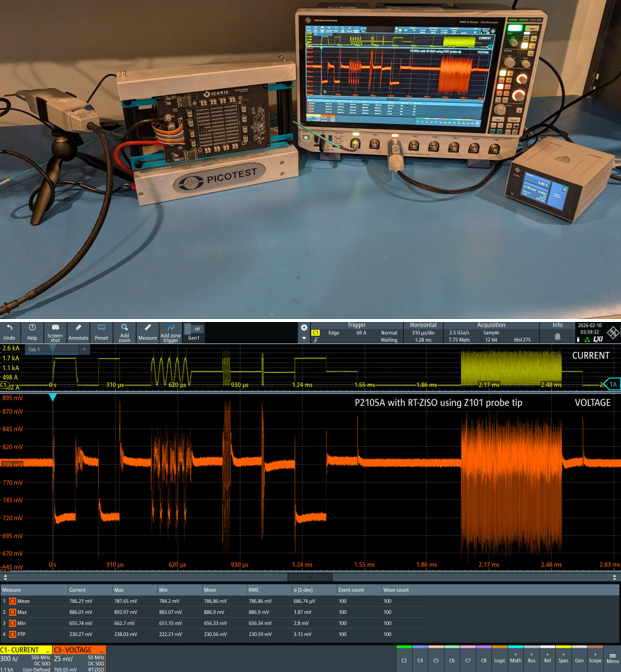 Figure 7. Measurement setup and result with R&S MXO5 with RT-ZISO with Z101 probe tip, and Picotest P2105A.
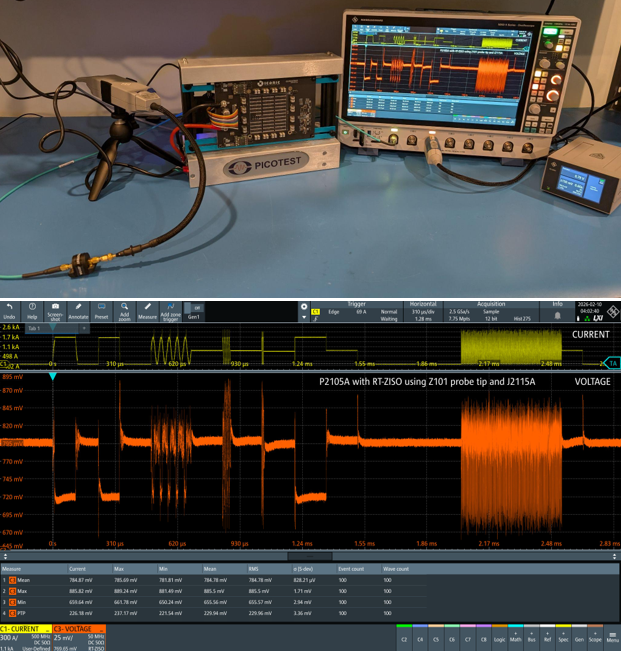 Figure 8. Measurement setup and result with R&S MXO5 with RT-ZISO with Z101 probe tip, Picotest P2105A, and J2115A.
Table 1. Summary of Measurement Results
Measurement Configuration |
Ave Voltage Measurement Over 100 acquisitions |
Measurement Improvement (Delta) |
Percent Change |
| P2105A Only | 263.68 mVpp |
0 |
0% |
| P2105A with J2115A | 262.79 mVpp |
-0.89 mVpp |
-0.34% |
| P2105A with RT-ZPR20 | 233.94 mVpp |
-29.74 mVpp |
-11.28% |
| P2105A with RT-ZPR20 with J2115A | 232.12 mVpp |
-31.56 mVpp |
-11.97% |
| P2105A with RT-ZISO with Z101 probe tip | 230.56 mVpp |
-33.12 mVpp |
-12.56% |
| P2105A with RT-ZISO with Z101 probe tip and J2115A | 229.94 mVpp |
-33.74 mVpp |
-12.80% |
| Largest Measurement Delta | 33.74 mVpp |
Analysis and Conclusion: The Cost of Inaccuracy
Our findings confirm that measurement uncertainty of this magnitude is indeed oscilloscope agnostic. Whether using a Tektronix or R&S platform, the physics of noise floors and ground loops remains unchanged. The observed 33.74 mVpp delta (12.80% improvement) is a critical metric for the success of AI hardware validation.
The "False Failure" Threshold
In modern Data Center and AI designs, power rails are governed by extremely tight DC and AC ripple specifications, commonly in the range of +/-5%. When we apply this to a standard 0.8V PDN rail, the allowable voltage ripple limit at the BGA balls is a mere +/-40mV.
If a measurement setup introduces 33.74 mVpp of error — driven by both probe noise and ground loop artifacts — one is consuming nearly 85% of the total error budget with measurement artifacts alone. This leads to a catastrophic "False Fail" scenario:
- Unnecessary Redesign: Designers may conclude that a VRM or decoupling strategy has failed to meet specifications at the BGA interface, triggering costly and unnecessary board re-spins or package optimizations.
- Invisible Margins: When the measurement error is nearly the size of the entire tolerance window, it becomes impossible to determine the true performance or stability of the PDN.
Solving for Both Culprits
While probe noise is a major factor (further explored in Reference 2), the common-mode noise induced by the ground loop between the high-current DUT and the oscilloscope is often the more dominant disruptor in high-current AI environments. This experiment proves that simply switching oscilloscope vendors will not solve the problem—the solution lies in the probing chain.
Using a combination of a low-noise, high-CMRR isolated probe (R&S RT-ZISO) and a coaxial isolator (Picotest J2115A) effectively addresses both primary culprits. This setup maximizes CMRR and minimizes the noise floor, ensuring that the results reflected on the MXO oscilloscope represent the actual rail behavior at the BGA balls, not the artifacts of the test environment. Addressing this 12.80% margin of error is paramount for achieving the reliable, high-fidelity data required to validate the next generation of AI and supercomputing hardware.
REFERENCES
- S. Brokaw, S. Sandler. “Seeing Through the Noise: Reliable Power Rail Measurements in High-Current AI Systems,” Signal Integrity Journal 2025.
- B. Dannan. “Low Noise Power Integrity Measurements - A Guide to Effective Probing with MXO58 Oscilloscope,” Signal Edge Solutions Blog 2024.
- S. Sandler, B. Dannan, H. Barnes, and I. B. Ezra. “Power Delivery Network Master Class on 2000A: How to Design, Simulate, & Validate,” DesignCon 2025.
- B. Dannan, S. Sandler. “Correcting Ground Loop Errors in Multi-Channel Oscilloscope Measurements with Power Rail and other Single-Ended Probes,” EDICon 2024.
- B. Dannan. “Analyzing Large Signal Phenomena and Crosstalk in Time and Frequency Domain and Avoiding Ground Loop Effects”
- B. Dannan, T. Huddleston, S. Sandler, H. Barnes, V. Chaphekar, K. Rapolu. “Methods to Model and Measure Noise Mitigation with Embedded Capacitors in High Current PDNs for AI and Cloud Compute,” DesignCon 2026.
- B. Dannan, et. Al. “Improved Methodology to Accurately Perform System Level Power Integrity Analysis Including an ASIC die,” DesignCon 2022.
- Picotest P2105A
- R&S MOX5
- Picotest J2115A
- R&S RT-ZISO
- R&S RT-ZPR20