The amount of data being processed is increasing exponentially and there’s no end in sight. In 2024, 147 zettabytes (ZB) of data were processed. Compare this to 181 ZB of data expected to be generated in 2025. That’s 2.5 quintillion bytes each day, or 29 terabytes per second.
Data growth is due to many factors. At the top of the list is artificial intelligence — unsurprisingly. Other reasons include high-definition video streaming and the continued rollout of IoT use cases, from autonomous driving and telehealth to smart manufacturing.
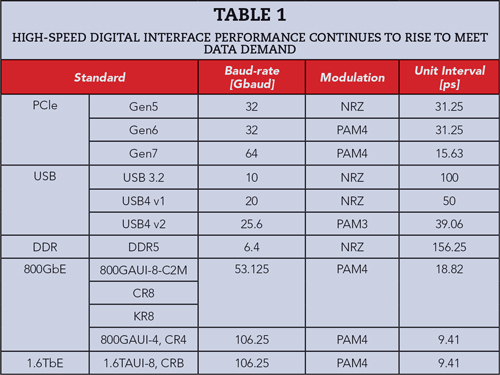
To keep pace, high-speed digital interfaces used in computing, server, storage, and other data systems are evolving rapidly. Table 1 lists the performance of each recent generation of PCI Express®, USB, DDR, and Ethernet, displaying how they all have increased in speed and baud rate to meet the exploding data transmission demand.
Given the high bandwidth that these digital interfaces must support, design verification becomes more complex for engineers. Traditional characterization methods have limited capability or are not granular enough to confidently identify errors and anomalies in addition to ensuring standards compliance. A new methodology introduces skew delay generation using delay blocks in two Pulse Pattern Generators (PPGs) to conduct highly accurate intra-pair skew measurements with the detail necessary to meet modern design requirements.
Let’s look at PCIe interfaces as an example. PCIe Gen6 has a UI of 31.25 ps. A printed circuit board (PCB) with a dielectric constant of 3.5 and 5 mm trace length strip-line for a PCIe Gen6 interface highlights the importance of skew testing. Figure 1 shows the frequency domain effect of intra-pair skew of a PCIe Gen6 MCP interface at 32 Gbaud rate with a 1 UI unit time. As shown, there is a steep dip at the Nyquist frequency of 16 GHz with a maximum difference of about -8 dB when compared to 0 mUI.
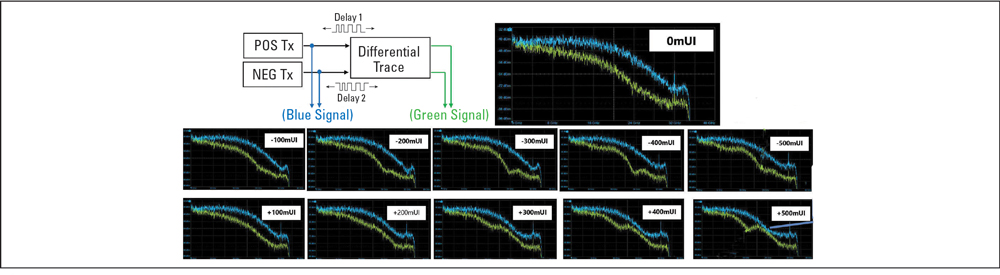 Figure 1. Frequency domain effect of intra-pair skew of a PCIe Gen6 MCP interface.
PAM4 is the preferred modulation scheme for high-speed interfaces because it significantly improves data speed, yet only requires bandwidth similar to NRZ. Because PAM4 transmits two bits per symbol by using four distinct amplitude levels, it requires precise timing to accurately distinguish between the different levels, especially when signals are close together in time. Therefore, PAM4 signals are highly sensitive to intra-pair skew.
In PAM4, the differential signal when the skew is 0 UI maintains the shape of POS (or the inversion of NEG). When the skew increases, the differential signal is degraded, and it becomes difficult to distinguish 1 or 0 levels as a digital signal.
Excessive intra-pair skew can lead to a sharp rise in bit error rate (BER), especially at data rates of several gigabits per second or higher. Once skew is added, further BER degradation occurs. Generally, the higher the order of Pseudo Random Bit Sequence (PRBS) the higher the BER (see Figure 2), as timing mismatches compromise the receiver’s ability to correctly interpret the data.
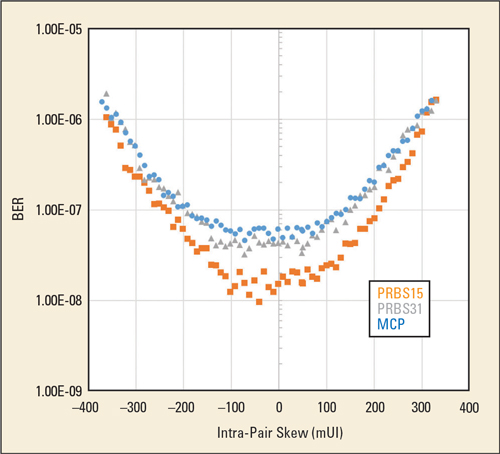 Figure 2. The addition of skew degrades BER, making it difficult for receivers to interpret data.
Accounting for pattern sensitivity, the BER impact from intra-pair skew can range from between 0.5 to 1 order of magnitude at 0.2 UI, so it can be a significant contributor to overall system margins. Test solutions and protocols must have tight control over intra-pair skew to ensure signal integrity and optimal data transmission quality as a result.
It is clear that intra-pair skew is an important factor to consider in system design. To overcome intra-pair skew challenges associated with high-speed digital interfaces, advanced and innovative evaluation solutions must be implemented to ensure highly accurate measurements.
The problem with this method is that it generates skew by creating what is called a trombone trace. In effect, a trombone trace is a routing pattern on a PCB designed to increase the length of one of the traces in a differential pair, thereby compensating for intra-pair skew. It adds a series of bends or loops, which can create significant challenges to accurately characterize designs. The bends and turns often create variations in impedance, leading to signal reflections.
Secondly, a trombone trace on one leg often has a different delay per unit length compared to the straight trace on the other leg. The adverse effect is mode conversion that may negatively impact the signal.
Another major issue with the arbitrary intra-pair skew approach is that the adapters that often introduce the skew can vary in length by as much as ~0.2 in. This makes it difficult to quantify the skew. Further, the method simply cannot truly support higher data rates, in large part because the skew steps are not very granular.
New Test System Configuration
Because the traditional coaxial adapter approach is unsatisfactory for modern high-speed interface designs, an improved test approach is necessary. The new methodology incorporates a high-speed Bit Error Rate Tester (BERT) with integrated PPGs for measuring performance under varying skew conditions.
Enabling this capability requires the use of dual transmitters on the BERT (see Figure 3). Dual transmitters are used for single-ended control of the phase of the signals within the differential pair. The transmitters need to be clock- and jitter-synchronized, yet are independently controlled by phase from the second PPG module. The setup is not currently in the standard CEM Compliance Test configuration, but it is suggested for accurate skew testing.
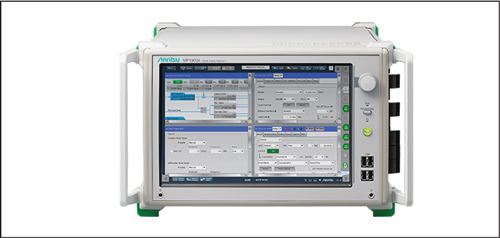 Figure 3. A high-quality BERT is needed for verifying high- speed digital interfaces currently in development.
The synthesizer serves as the clock source. Optionally, the clock can be fed into a synthesizer from a 100 MHz source. The jitter module is used to produce multiple synchronized clocks to feed each PPG and add jitter. Skew is introduced by a delay block inside each PPG. The delay can be advanced or regressed by dialing skew in POS or NEG direction as needed.
Need for Calibration
Given the precise measurements required to verify today’s high-speed designs, calibration is important for accurate characterization. It ensures the best match between POS and NEG. Parameters that must be matched between the two PPGs during calibration include amplitude, edge rate, duty cycle, jitter, and equalization.
Figure 4 shows results from the test setup. The display reveals the effect of skew on a PAM4 eye at 64 GT/s of a PCIe 6.0 interface with 2 mUI resolution, which is 0.0625 ps for PCIe 6.0. Based on the results, the intra-pair skew can have quantifiable impact to BER margins on PCIe at 64 GT/s, even without any additional impairments.
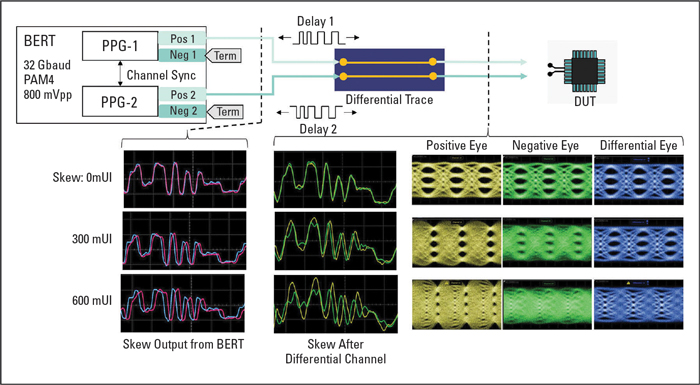 Figure 4. Test setup and results of the effect of skew on PAM4 eye at 64 GT/s.
 Summary
The BERT-based setup uses a new method with dual transmitters to control the phase of signals within a differential pair, enabling granular measurement of intra-pair skew. This capability is crucial for understanding and mitigating the impact of skew on BER margins at high data rates such as 64 GT/s.