
As data rates continue to scale into the multi-tens of gigabits per second, the tolerance for uncertainty in interconnect behavior has significantly diminished. At the same time, packaging and board-level technologies are evolving toward higher density, heterogeneous integration, and greater compliance with standards. These trends have driven widespread adoption of meshed reference planes, including cross-hatch ground planes in flexible and rigid-flex designs (see Figure 1), and perforated planes with degassing holes in 3D-IC packages (see Figure 2).
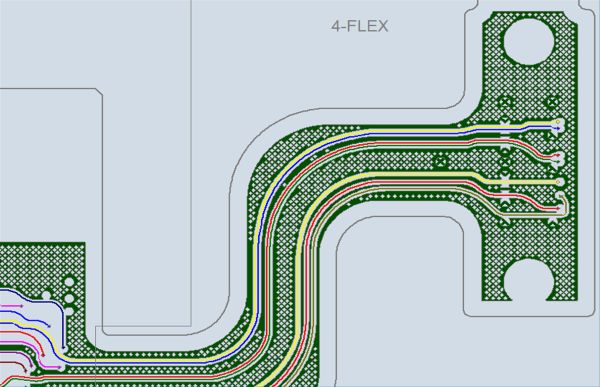
Fig. 1 Flexible and rigid-flex meshed plane design with cross-hatch planes.
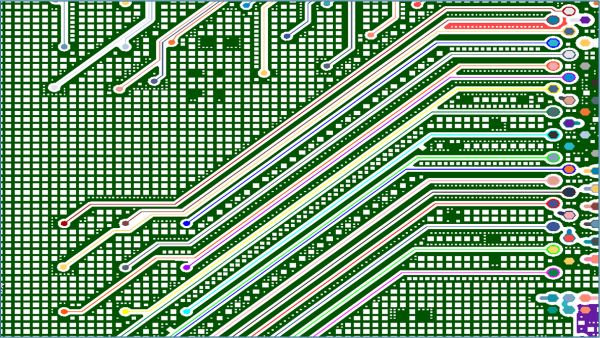 Fig. 2 3D-IC package design planes with degassing holes.
From an electromagnetic (EM) perspective, meshed planes are a departure from the continuous reference planes assumed in most analytical and quasi-static models. The discontinuities introduced by the mesh alter current return paths, increase effective inductance, and can lead to non-uniform field distributions. These effects impact both signal integrity (SI), through changes in characteristic impedance, delay, coupling, and power integrity (PI), through degradation of power distribution network (PDN) impedance and resonance behavior.
Conventional approaches to modeling meshed planes rely on 3D full-wave EM solvers. However, a single metal layer may contain thousands to millions of apertures, making direct simulation computationally expensive and often impractical for iterative design flows. Furthermore, SI and PI effects must often be evaluated simultaneously, further increasing model complexity. This article presents machine learning (ML)-based modeling approaches that efficiently characterize SI and PI behavior in systems with meshed planes.
Artificial neural network (ANN) models are developed for pre-layout SI analysis of traces referenced to meshed ground planes, with Bayesian optimization employed for systematic hyperparameter tuning. The proposed methods demonstrate high accuracy compared with 3D full-wave EM simulations while achieving orders-of-magnitude reduction in computation time. The results suggest that ML-enabled modeling can serve as a practical and scalable solution for SI/PI analysis of complex meshed-plane structures.
-
Geometric complexity: The sheer number of holes or mesh elements creates a large-scale 3D problem that is difficult to simplify without loss of fidelity.
-
Full-wave requirements: The EM behavior of meshed planes is inherently 3D, invalidating many quasi-static or 2D assumptions commonly used in interconnect modeling.
-
Computational cost: Applying 3D full-wave methods to such structures requires substantial memory and runtime, limiting their use in early design stages.
-
Coupled SI and PI effects: Meshed planes simultaneously affect signal return currents and power delivery paths, necessitating a unified modeling approach.
To address these challenges, ML models are being introduced as surrogate models for EM-based SI analysis. They focus on traces referenced to meshed ground planes, particularly cross-hatch structures commonly used in flexible and rigid-flex boards (see Figure 3).
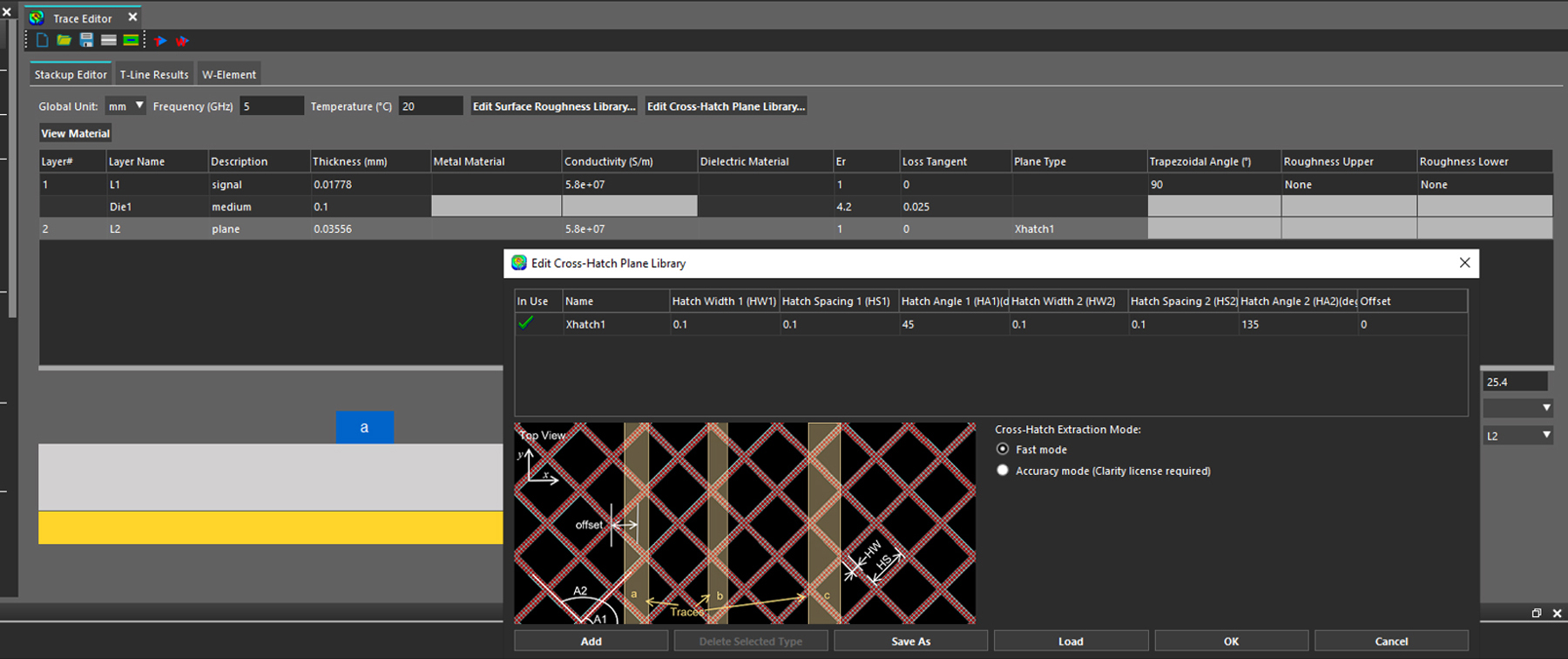 Fig. 3 Pre-layout SI analysis trace editor referenced to meshed ground (cross-hatch) planes.
ANNs offer sufficient flexibility to approximate the nonlinear relationships between meshed-plane geometry and EM response. However, model performance is strongly influenced by hyperparameter selection, including hidden layer count, hidden dimension, learning rate, and training epochs.
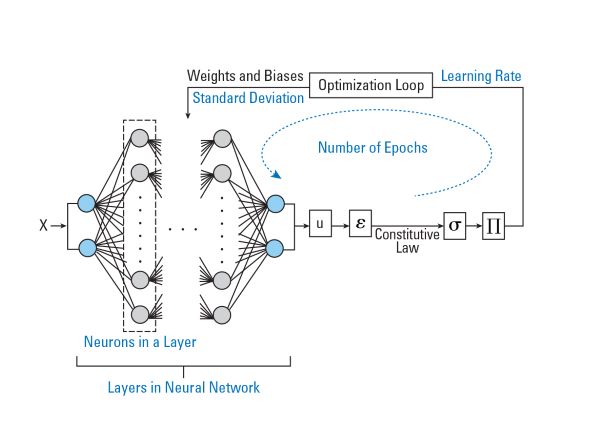
Fig. 4 Bayesian optimization for ANN hyperparameter tuning.
- This approach provides several advantages:
- Systematic exploration of the hyperparameter space
- Flexible search domains, allowing continuous parameter ranges rather than discretized values
- Efficient convergence, achieving improved accuracy with fewer training iterations.
Notably, the hidden layer dimensions are not constrained to traditional powers-of-two conventions, enabling more efficient network configurations.
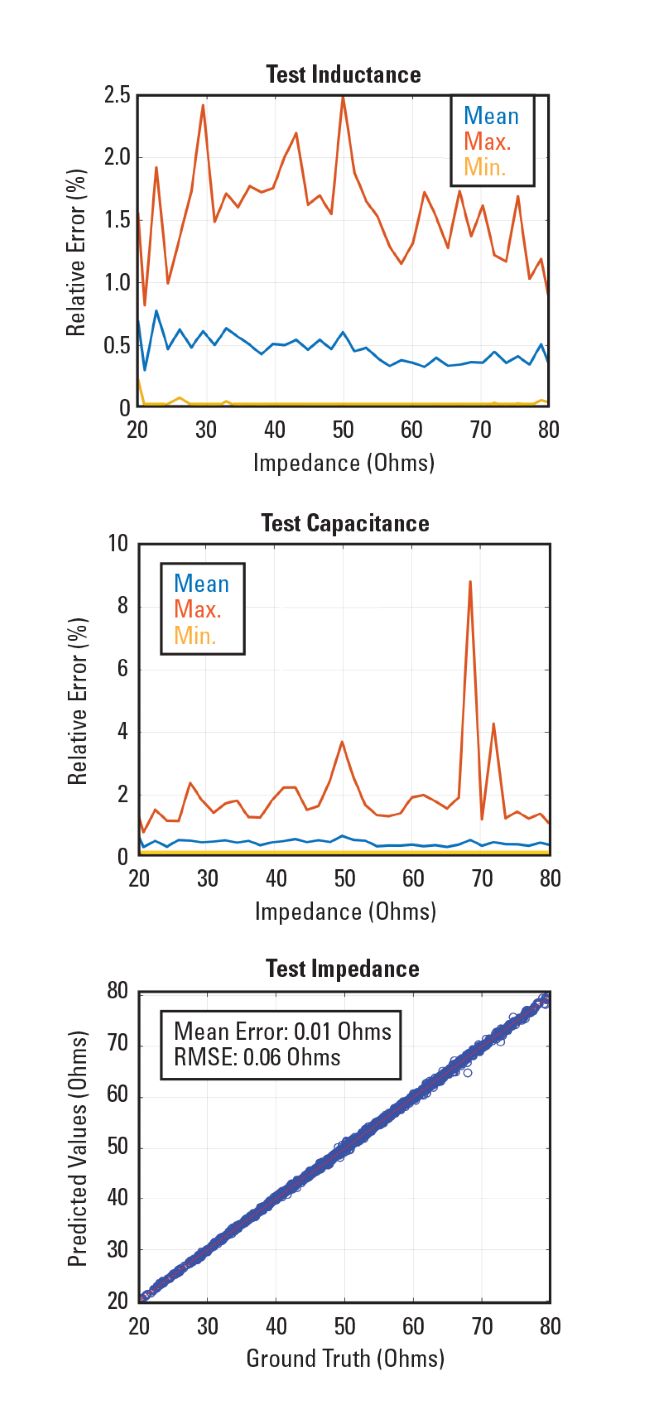
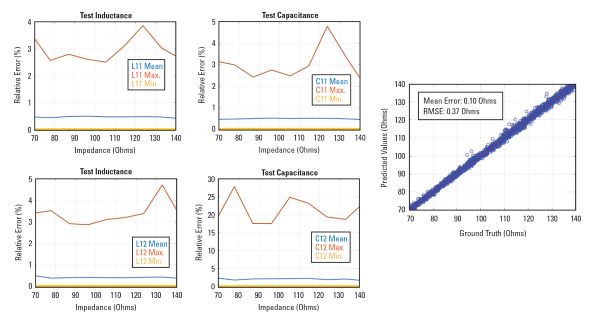
Fig. 6 ANN validation of coupled trace microstrip with cross-hatch planes.
In addition to pre-layout SI modeling, ML models can be extended to SI/PI analysis of meshed planes by integrating them into hybrid EM solver workflows. This approach uses ML models to rapidly characterize the local EM behavior of meshed planes, while the hybrid EM solver captures global interactions across the package or board (see Figure 7).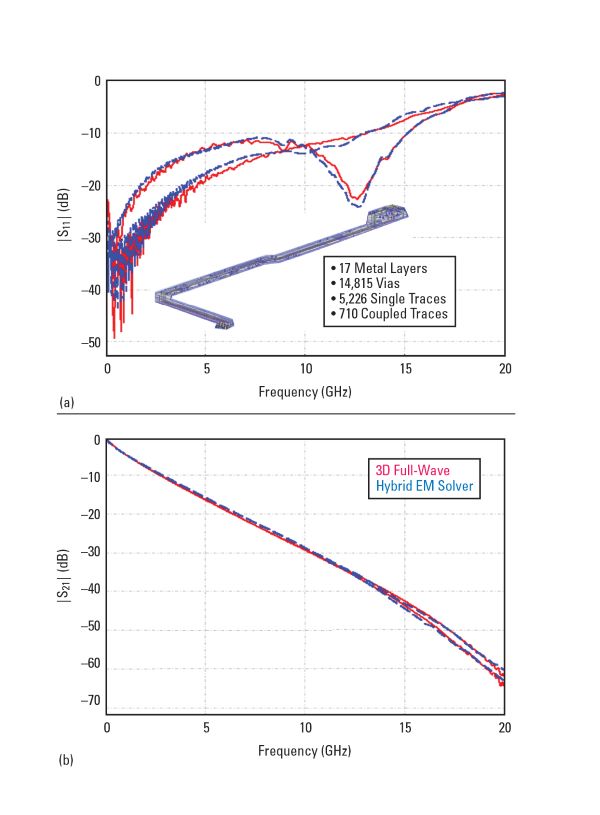
Fig. 7 The hybrid EM solver leverages ML techniques to extract part of a layered interconnector with high efficiency and reliability: (a) return loss and (b) insertion loss.
The trained ANN models for parallel-meshed planes were used to correct the finite elements of the parallel-plane field domain, while the ML-based models for traces referenced to meshed ground were used to correct the transmission-line parameters of traces.
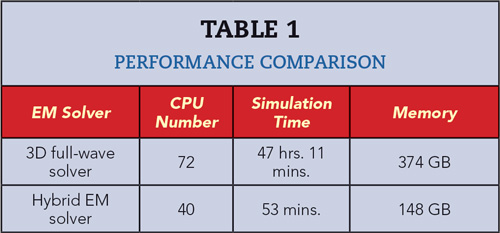
The hybrid EM solver leveraging ML models was used to extract the S-parameters of a small part of a layered interconnector with 17 metal layers, 14,815 vias, 5,226 single-ended traces, and 710 coupled traces (the complete structure is out of the capability of 3D full-wave simulation). The extraction was conducted on a Windows server with an Intel Xeon processor and 1.0 TB of RAM. The extracted return loss and insertion loss agreed well with the 3D full-wave simulation in a broad frequency region, as shown in Figure 7. The hybrid EM solver is much faster than 3D full-wave simulation and has obtained up to 50x speedup with consistent accuracy. It also requires less memory, as compared in Table 1.
Key Takeaways
- Meshed reference planes significantly alter current return paths and cannot be accurately modeled using solid-plane assumptions
- Direct 3D full-wave simulation of meshed planes is often impractical for iterative design flows
- ML models can accurately predict SI metrics such as impedance and delay when trained on high-quality EM data
- Bayesian optimization provides an efficient and robust method for ANN hyperparameter tuning
- ML-based surrogate models are well-suited for pre-layout analysis and early-stage design exploration involving meshed planes.