In the relentless push toward faster digital communication and higher data throughput, signal integrity (SI) has emerged as a fundamental design challenge. Among various forms of signal degradation, skew — defined as the differential timing delay between two logically paired signals, often in differential pairs — is a key contributor to timing errors in systems operating at multi-gigabit data rates.
While conductor length mismatch is a known cause, an increasingly important factor at high speeds is material-induced skew due to local differences in dielectric constant arising from the PCB’s woven glass fabric reinforcement. This article aims to unpack the root causes of material-induced skew, particularly focusing on the glass weave effect, and explores mitigation techniques ranging from laminate selection to signal routing strategies.1
Origins of the Glass Weave Effect
Most rigid multilayer PCBs use woven glass fiber reinforcement in the dielectric to provide mechanical strength and thermal stability. This woven glass has a Dk of approximately 6 for standard e-glass to 4.5 for newer generation low Dk glass, while the resin matrix (e.g., Thermoset (PPE, Hydrocarbon) or PTFE-based systems) ranges from 2.1 to 3.8 Dk.
When a trace overlays different portions of this weave — such as a glass bundle (knuckle) versus an open resin pocket — the effective Dk seen by the trace can vary, leading to differential propagation delays between conductors in a pair.2 Over lengths of several inches, even small local variations can integrate into measurable skew, especially for thin dielectric layers or small-width conductors. Figure 1 shows how the placement of the conductor can overlap different portions of the PCB glass and resin, resulting in variations in dielectric constant, causing skew.
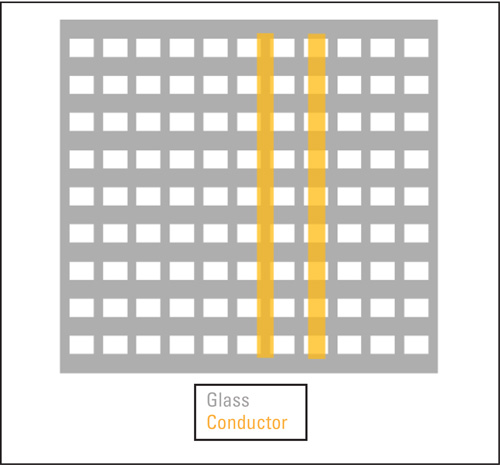 Figure 1. Diagram showing how the placement of the conductor can overlap different portions of the PCB glass and resin, resulting in variations in dielectric constant and therefore causing skew.
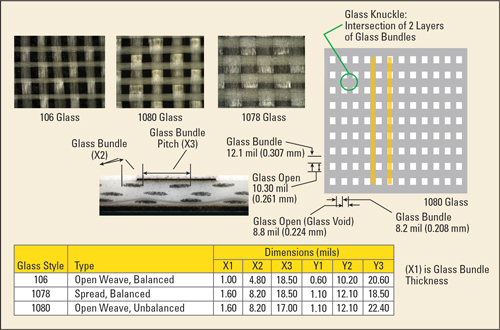 Figure 2. Some common standard glass styles with dimensions of glass bundles vs. resin.
 Quantifying the Impact of the Glass Weave Effect
After the circuits were fabricated on these three styles of glass PCBs, thorough inspections were done to choose the appropriate circuits for testing (see Figure 3). Chosen for testing were circuits with the signal conductor aligned to the glass knuckle-bundle run (high Dk), and circuits with the signal conductor aligned to the glass bundle-open run (low Dk). It was very difficult to find a circuit with a consistent alignment between the conductor and glass-weave pattern. Typically, there was one appropriate circuit out of 40 to 60 circuits.
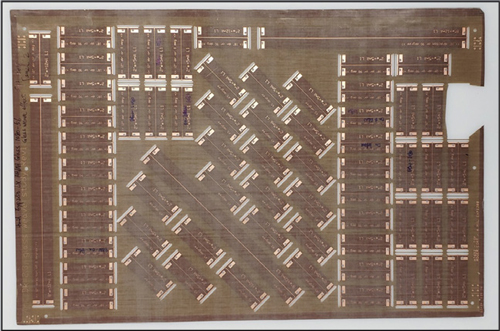 Figure 3. Test circuits fabricated on different glass styles of PCBs for testing.
Time domain reflectometry and vector network analyzers were used with rise times down to 3.2 ps and bandwidths up to 110 GHz. Fast rise time is essential to resolve fine impedance variations from weave transitions. Impedance anomalies as small as 0.5 mils in trace width were detected — sufficient to produce a 1 Ω impedance swing. A network analyzer was used to measure the following properties: phase angle (unwrapped), group delay (based on phase angle which varies with frequency), propagation delay, effective Dk measurements based on phase angle, and impedance from reflected S11 and S22. Comparisons of these properties were done with circuits using 4 mil thick PTFE-woven-glass with 106 glass, 4 mil thick PTFE-woven-glass with 1080 glass, 4 mil thick PTFE-woven-glass with 1078 glass, and 4 mil thick RO4835™ LoPro® laminate with 1080 glass. Rogers Corporation conducted extensive testing of various laminates using microstrip test vehicles at frequencies up to 110 GHz. Across three glass styles — 106 (standard), 1080 (open weave), and 1078 (spread weave) — data showed significant variation in performance due to the interaction between signal traces and localized glass weave features.
Measured Results The average group delay data differences between traces aligned with knuckle-bundle versus bundle-open regions are shown in Table 1.
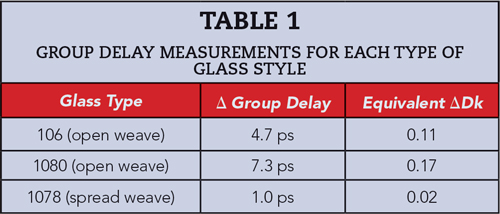
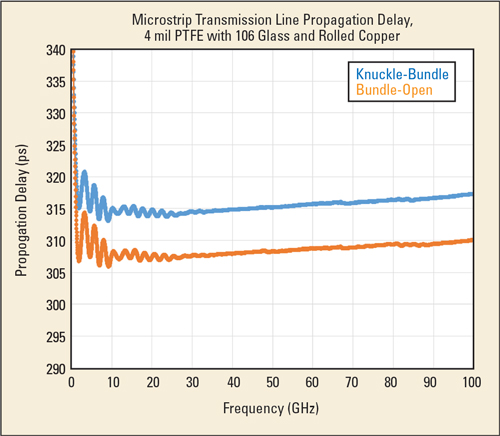 Figure 4. Microstrip transmission line propagation delay for 4 mil PTFE with 106 glass and rolled copper.
Using measured phase angle with the microstrip phase response formula finds effective Dk. Using Eff Dk, propagation velocity can be found, and from that, propagation delay can be found. A higher Dk will have a slower wave, which is increased propagation delay. For propagation delay, the average difference between 40 GHz and 80 GHz is 6.9 ps, which is equivalent to a Dk difference of 0.15.
The test results for phase angle show the difference at 77 GHz of 100°, which is equivalent to a Dk difference of 0.09 (see Figure 5). This is the most accurate measurement given that it uses raw phase angle measurements from the network analyzer. A higher Dk will have an increased phase angle (more negative value, as formatted below). Test results for phase angle show the equivalence of 0.09 Dk at 77 GHz.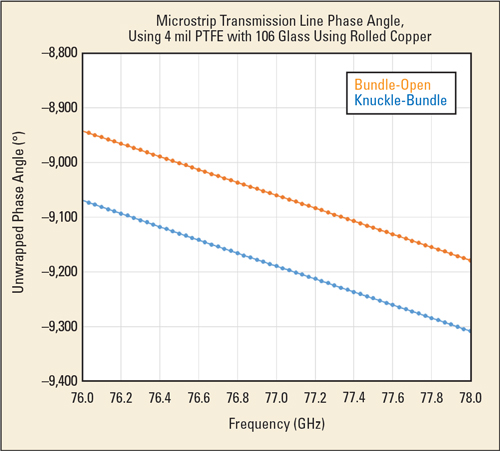
Figure 5.
Microstrip transmission line phase angle for 4 mil PTFE with 106 glass and rolled copper.
The average impedance difference is 3.1 Ω, which is equivalent to a difference in Dk of 0.40. The general trends are correct, but the impedance value is not correct for extracting Dk only. The circuits had a difference in conductor width and copper plated thickness that alters the impedance values much more than the glass-weave effect on Dk. The time axis for the impedance curve is round trip, or the time is half, as shown in Figure 6. A higher Dk will have a lower impedance and longer (slower) propagation time.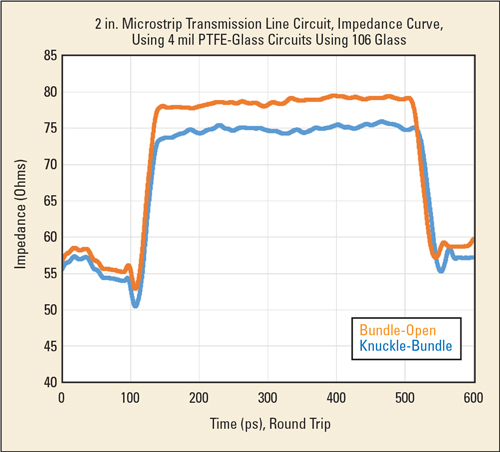 Figure 6. 2 in. microstrip transmission line circuit impedance measurement for 4 mil PTFE with 106 glass and rolled copper.
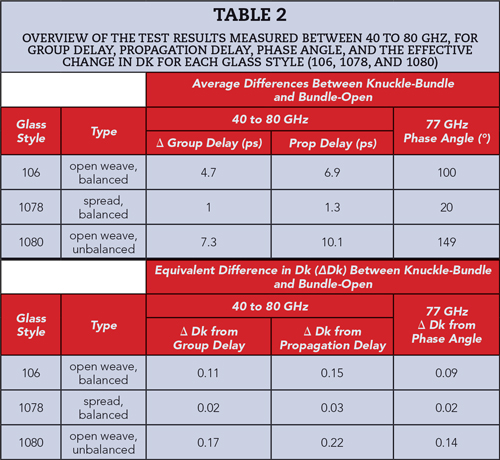
This summary of the data in Table 2 highlights how spread weave glass styles significantly reduce the skew-inducing effects by smoothing Dk variation.
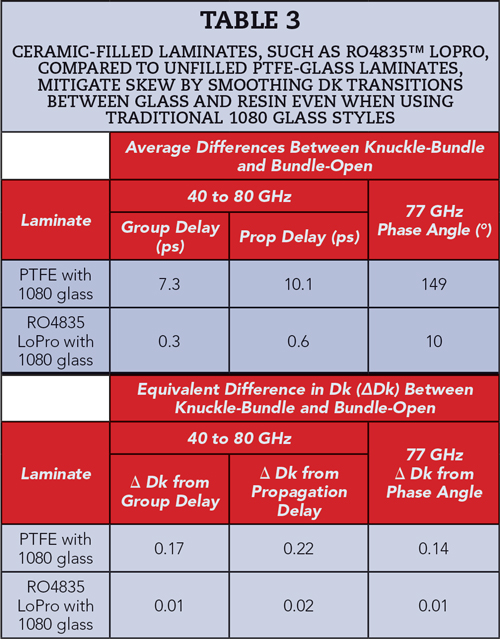
Ceramic-filled laminates, such as RO4835™ LoPro, shown in the test results, mitigate skew by smoothing Dk transitions between glass and resin. Compared to unfilled PTFE-glass laminates, ceramic-filled systems demonstrated lower Dk variation and minimal skew, even when using traditional 1080 glass styles.
A laminate with filler, which is usually a different Dk than the glass and the resin system, will help to minimize the Dk transitions between the glass fabric and the resin system (see Figure 7). Smoothing the Dk transitions is helpful for reducing the glass-weave effect; however, the effect can still be observed, although to a lesser extent than unfilled glass reinforced laminates.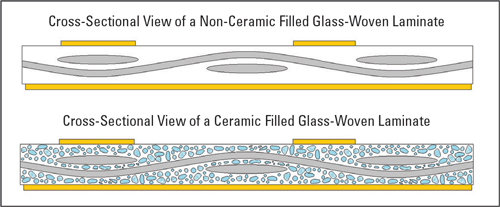 Figure 7. Cross section view of a non-ceramic filled glass-woven laminate versus ceramic filled.
Table 3 shows test results for 1080 glass with laminate unfilled vs. filled, proving that a ceramic filled laminate significantly reduces the glass-weave effect on skew. Further to this improvement, RO4835TTM (a ceramic loaded thermoset similar to 4835 LoPro) and XtremeSpeed GB series© (a ceramic loaded PTFE) use advanced glass material specifically for high-speed, low-loss digital applications. These materials are constructed with spread glass 1078 and 1035 to further even the Dk distribution in the XY plane.
The results from this study used laminates with electro-deposited (ED) copper. Most ED copper does not have directionality. Rolled copper is extremely smooth and has a natural directionality, as one axis of the copper is slightly rougher than the other axis. The copper directionality typically has a small influence on circuit performance due to panel orientation, but for thin circuits, it can have some impact. The surface of rolled copper is shown in Figure 8 at high magnification from a scanning electron microscope photograph.
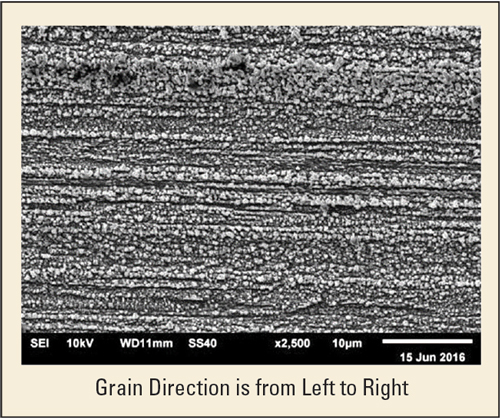 Figure 8. Surface texture of rolled copper as seen on a scanning electron.
Skew Mitigation Strategies: Material Construction
Using materials that have no glass fabric, such as RO3003™ and RO3003G2™, will yield the best results for minimizing skew. However, this is not practical in constructing high layer count, tight pitch, dense PCBs, as registration of inner layer circuits typically requires the use of woven glass for dimensional stability.
Minimizing the amount of glass for a given dielectric thickness to maximize the spacing between conductor and glass, using laminate and prepreg bond ply materials such as RO4835T™/RO4450T™, and the newest material soon to be released for Gen 9 designs, XtremeSpeed RO1201™ laminate constructed with readily available low Dk spread glass and RO1101B prepreg bond-ply without any glass fabric combined with resin formulations that contains ceramic fillers for extremely low-loss multilayer stripline, will minimize or eliminate skew effects, differential pair 224Gb/s PAM4 performance, and avoid the use of limited supply glass and quartz.
Circuit Orientation
Skew mitigation has also included PCB rotation of ~12° relative to the glass cloth directional weave of the laminate and prepreg supplied panels.3 Zig-zag routing also helps to average out local Dk transitions by traversing multiple wave regions.3 These are intended to route a differential pair such that both traces experience the same dielectric zones.
With PCB rotation, the downside is that efficient utilization of the materials is lost. For example, if two PCBs each occupy 12 × 18 in. on a standard 18 × 24 in. panel, a rotation of 12° will yield only one PCB per 18 ×24 in., resulting in twice the material cost per PCB.
REFERENCES
1. Paper adapted from J. Coonrod Presentation, “An Overview of Glass-Weave Impact on Millimeter-wave PCB Performance,” Microwave Journal webinar, October 2018.
2. A. F. Horn, III, J. W. Reynolds, and J. C. Rauto, “Conductor Profile Effects on the Propagation Constant of Microstrip Transmission Lines,” IEEE Tran. Microw. Trans Theory Tech. Symposium, 2010.
3. J. Loyer, R. Kunze, and X. Ye, “Fiber Weave Effect: Practical Impact Analysis and Mitigation Strategies,” DesignCon, Santa Clara, 2007.