Emphasis on high-frequency electromagnetic field solvers often overshadows the need for simulation models in low-frequency bandwidths. Many high-frequency field solvers are not well suited to accurately extract the RLGC (resistance, inductance, conductance, and capacitance per unit length) and S-parameter behavior of transmission line structures at lower frequencies. This kind of modeling often requires the use of alternate tools and methods to achieve accurate parameter extraction, and these techniques can vary depending on the application and model complexity.
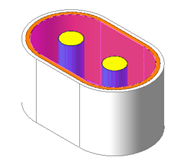 Figure 1. Sample twin-axial cable geometry.
 Field Solver Options
Ansys HFSS (High-Frequency Structure Simulator) is a widely used, high-frequency electromagnetic simulation tool included in the Ansys Electronics Desktop software package. The tool typically performs well and delivers accurate solutions for models simulated at frequencies ≥ 1 GHz, but the accuracy and convergence of the tool begin to gradually deteriorate below this threshold in addition to lengthy solve times, can lead to HFSS not being the optimal choice for certain lower frequency simulations.
Ansys Q3D Extractor is the low-frequency counterpart to Ansys HFSS. It considers the electric and magnetic fields decoupled, which is a reasonable assumption at low frequencies, but for this reason it is not positioned for high-frequency analysis. The tool can simulate and produce S-parameter results at much lower frequencies extending all the way down to DC, making Q3D a popular choice for simulation of complex, nonuniform models at low frequencies. However, just like in HFSS, computing resource demands and solve times can increase with model scale and complexity to the point of impracticability. Additionally, HFSS’s port de-embedding feature that is designed to save valuable time and resources in the simulation of uniform transmission line models is not available in Q3D. In uniform cable and transmission line geometries with large aspect ratios, this can lead to unnecessarily large memory requirements and solution times.
This gap in low-frequency simulation of large aspect ratio uniform structures is effectively filled by using Ansys Q2D Extractor. Like its three-dimensional counterpart, Q2D is a quasi-static parameter extractor that operates only in two dimensions rather than three. Q2D takes the two-dimensional (2D) cross section of a three-dimensional (3D) model and calculates its per-unit-length frequency-dependent RLGC parameters, allowing arbitrary length scalability and making it well suited to simulate lengthy cable and transmission line models with uniform cross sections. For our desired frequencies, a quasi-static solver like Q2D is sufficient. For simulation of higher
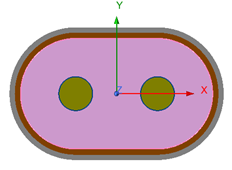 Figure 2. Twin-axial cable cross section after importing to Q2D from Q3D.
Figure 2 shows the result of importing a 3D twin-axial cable model into Q2D — slicing it down to its 2D cross section with no regard to its length along the third dimension. The HFSS model geometry is copied and pasted into a Q3D design, which is used to create the Q2D cross section. Both the center wires and the outer shield are selected as conductors with the solve type set to “automatic.”
The center wires are set as signal paths, and the outer shield is set as a reference ground. The conductor selections and solve option setup details are pictured in Figures 3, 4, and 5.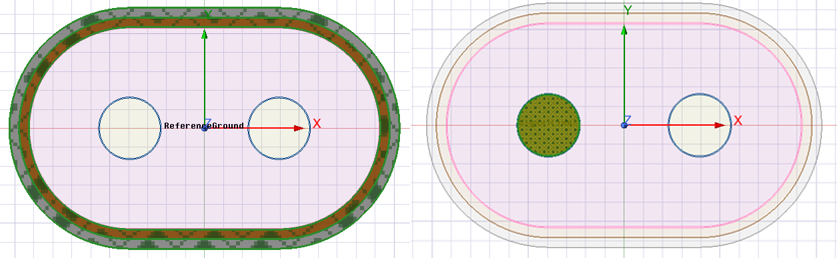 Figures 3 and 4. Conductor selections for reference ground (Figure 3, left) and signal paths (Figure 4, right).
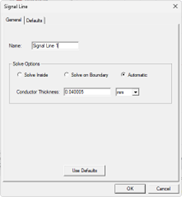 Figure 5. Setup window that appears when setting a conductor, including all solve options.
Circuit and Correlation Considerations
Adding a solution setup, frequency sweep, and solving the design allows the user to export the solution data as a full-wave SPICE tabulated or compact W-Element circuit model, with many additional circuit formats available for export as displayed in Figure 6. Q2D also allows direct exporting of S-parameter data for a single specified length, which allows the user to scale the results to different model lengths on the condition that the original design is available. 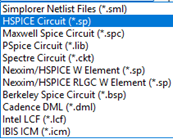 Figure 6. List of all possible formats to export Q2D solution to circuit.
Next, we placed this model into Ansys Circuit design, where after making the necessary port connections (see Figure 7) it can be scaled to any desired length and simulated for the same frequency sweep to produce accurate S-parameter results. Note that the selected reference conductor should be connected to ground at both ends.
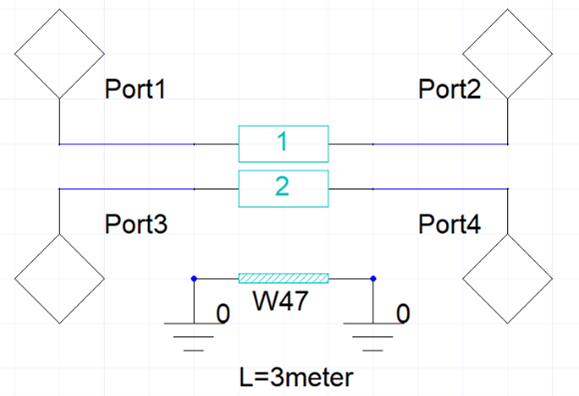 Figure 7. W-Element model and requisite port connections, with length set to 3 m.
 This completes the two-step solution and workflow to simulate arbitrary-length, uniform cable and transmission line models for low frequency S-parameter results. Figures 8 and 9 display two examples of the S-parameter correlation between measured data from a generic twin-axial cable for the frequency range DC to , and the same cable replicated and simulated for the same frequency range using Ansys Q2D and Circuit.
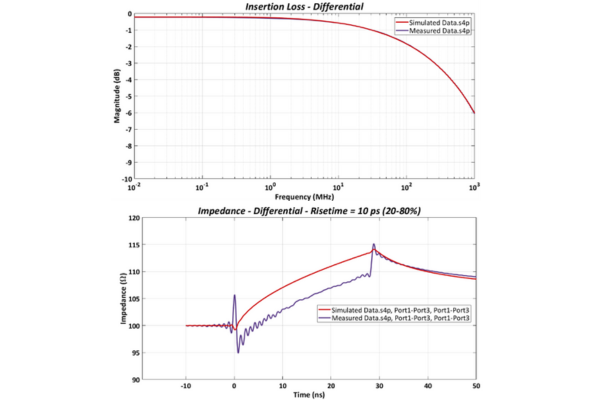 Figures 8 and 9. Differential insertion loss and TDR impedance correlation between measured and simulated twin-axial cable. Excellent differential insertion loss correlation creates the illusion of a single trace — there are actually two traces in Figure 8, they are just almost directly overlaid onto each other. A logarithmic scale is used to plot the differential insertion loss to let observers clearly view the low frequency behavior. Logarithmic scaling is also the standard for typical power integrity frequency ranges.
 The measuring instrument was a two-port, low-frequency VNA, which required multiple measurements to construct the four-port touchstone file. Different optimization methods were employed to ensure the consistency and repeatability of the measured data. For instance, there was noticeable change in the DC resistance of the shield as the cable had to be moved in between subsequent two-port measurements. This lead to the final, movement-restricting measurement fixture that is shown in Figure 10.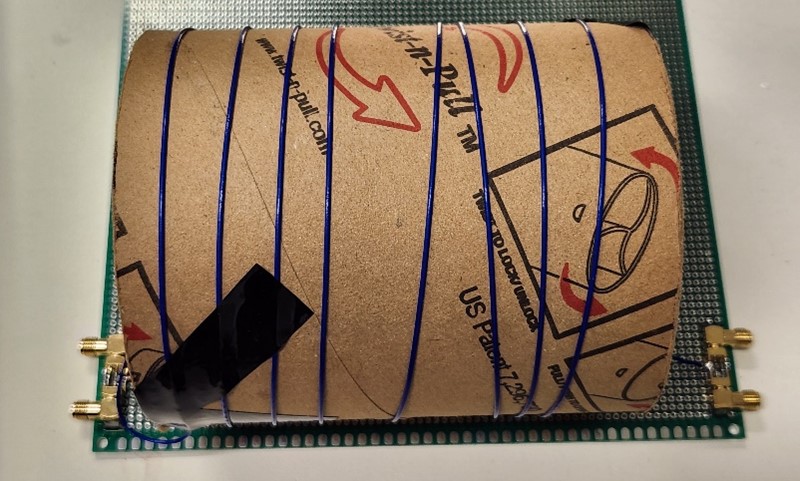 Figure 10. The twin-axial cable in its movement-restricting measurement fixture.
It should be noted that the simulation was completed using nominal geometry, whereas the measurement represents an arbitrarily selected cable sample. The two are not identical and, therefore, lead to observable S-parameter discrepancies. The conductivity of the outer shield was adjusted for better low frequency correlation, while the dielectric loss tangent of the dielectric material was adjusted for better high frequency correlation. Neither adjustment exceeded typical values for the given material. The differential insertion loss shows excellent correlation, but the TDR profile which was calculated from the S parameters reveals a several ohm difference between the nominal expected and actual measured impedance.
The two spikes at the beginning and the end of cable response in the TDR profiles in Figure 9 can be attributed to the inductive discontinuity caused by the hand-soldered fixtures (see Figure 11) used to connect the cable center wires to the vector network analyzer cables.
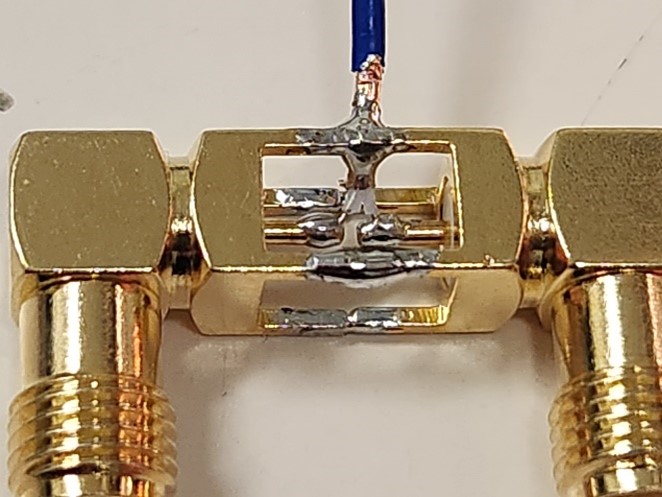 Figure 11. Close up view of the hand-soldered fixtures that connect the two center wires to SMA-female interconnects.
The quality of the four-port touchstone file constructed from the two-port data sets was checked for causality and passivity (see Figure 12).
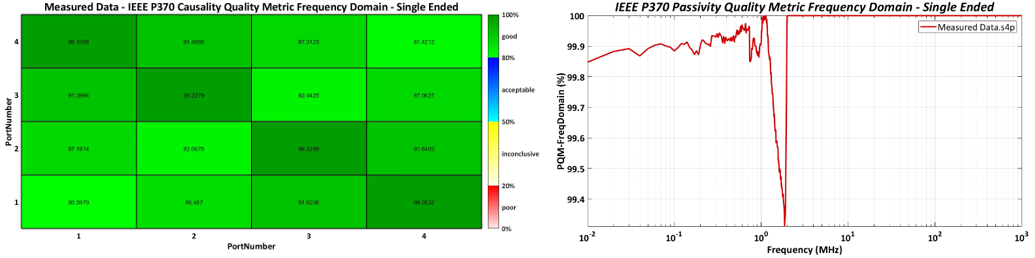 Figure 12. Single-ended causality plot (on the left) and passivity metric plot (on the right). Note that for the passivity plot, consideration of the y-axis scale (99.4 to 100%) indicates that the observable dip is actually very small, so it causes no concern.
 Summary
Using Ansys Q2D Extractor in tandem with Ansys Circuit presents an alternative solution to the simulation of lengthy, uniform cable and transmission line models at low frequency to DC bandwidths that would otherwise prove difficult and impractical to simulate using other field solvers. This process produces the same S-parameter results but for a fraction of the time and computing resources, allowing greater flexibility and faster analysis of these particular models and frequencies. Discrepancies in the correlation of the measured and simulated twin-axial cable used to validate this methodology can be attributed to either known physical discontinuities or can been eliminated using various optimization methods.
Acknowledgements
Special thanks to Dane Thompson and Juliano Mologni of Ansys for their consistent support, help with troubleshooting, and guidance throughout the simulation process. Thanks also to Scott McMorrow of Samtec for his insight and to Istvan Novak of Samtec Inc. for his mentorship throughout all stages of measurement, simulation, and documentation involved in this project and publication.