Most high-performance test instruments, including sampling oscilloscopes and vector network analyzers (VNAs), are single-ended, ground-referenced, 50 Ω instruments. There are now a growing number of electronic applications, both digital and analog, that are using differential circuit techniques and also balanced transmission lines. As a result, many engineers are being tasked to design new differential circuits without the benefit of having proper test instruments.
Most VNAs can be upgraded by the manufacturers by purchasing an optional, expensive, multi-port switch matrix to accompany 2-port VNAs. This article will offer a significantly lower-cost alternative. Instead of using a switch matrix, baluns can be used with conventional 2-port VNAs to perform differential measurements. Several companies offer ultra-wideband baluns that permit differential measurements to be made over extremely wide frequencies extending from the kHz range to well into the GHz band.
Baluns
Historically, when engineers needed to do differential measurements with conventional test instruments, they used a balanced to unbalanced transformer, or “balun” for short.
Figure 1 shows the typical schematic diagram for a balun. It consists of a simple transformer with one wire of the primary winding being the ground terminal for the unbalanced side. The balanced secondary winding is not connected to the ground terminal and is thus considered to be “floating” with respect to ground. Impedance transformation is also possible if the number of wire turns on the primary and secondary are unequal. The impedance transformation is equal to the square of the turns ratio (N). A classic example of a balun, which some may be familiar with, is the antenna transformer that used to be supplied with every TV receiver. It was used to match 300 Ω flat ribbon lead to 75 Ω coax cable. For a 300 Ω /75 Ω transformation, a 2:1 turns ratio is required.
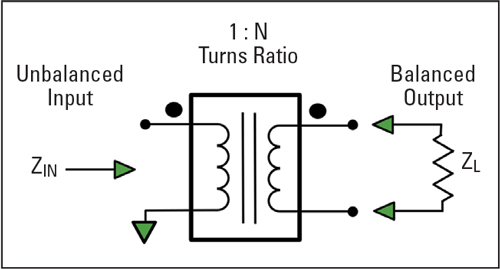
Figure 1. Balun transformer schematic diagram.
shows another example of a balun. In this case, the balanced secondary consists of two identical windings that are connected as a center-tapped secondary. The center tap is usually then connected to the common ground. Note that the black dots are polarity indicators for the various transformer windings. With the arrange-ment shown in Figure 2, one of the secondary outputs is “in-phase” with the input and is thus labeled as the (+), or “non-inverting” output. The other secondary output is “out-of-phase” with the input and is thus labeled as the (-), or “inverting” output. There is a 180-degree phase difference between the non-inverting and inverting outputs. There are now three output impedances to be considered. Z
L+ and Z
L- are the impedances referenced to ground seen looking into the non-inverting and inverting outputs, respectively. There is also a differential impedance, Z
DIFFERENTIAL, which is the impedance seen between the two center pins of the (+) and (-) output coax connectors. Z
DIFFERENTIAL = Z
L+ Z
L-. The impedance transformation is still determined by the turns ratio, N, of the secondary
and primary windings.
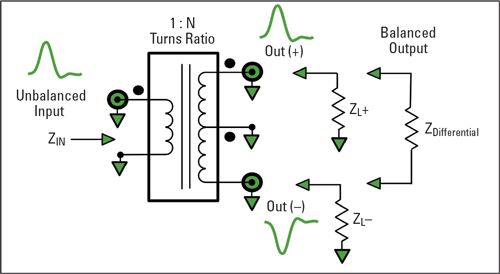
Figure 2. Balun transformer with center-tapped output schematic diagram.
The balun designs shown in Figure 1 and Figure 2 are very widely used and are available from many manufacturers. They can be used for balanced to unbalanced transformations and to shift impedance levels by altering the turns ratio, N. The major limitation in these designs is bandwidth. They are built using conventional transformer designs and techniques. The transformer core material, number of wire turns, etc. are dictated by the desired operating frequency. It is difficult to design transformers, including baluns, to operate over more than one or two decades of bandwidth. For typical “wireless” RF applications, ultrawide bandwidth is not a requirement. For example, the TV antenna transformer mentioned earlier only needs to work from 50 to 800 MHz. However, for digital data, ultrawide bandwidth is a mandatory requirement. Digital data systems, such as 5G, PCIe 6.0, and USB 3.0 require bandwidths extending from applications, the balun designs of Figure 1 and Figure 2 are unsatisfactory.
There are several methodologies for designing an ultra-wideband balun design that works over many decades of bandwidth. One of these designs is shown in
Figure 3. It consists of a
50 Ω
, impedance-matched, 6 dB power divider, a
50 Ω
coaxial inverting 1:1 transformer, and a length of
50 Ω
coax cable.
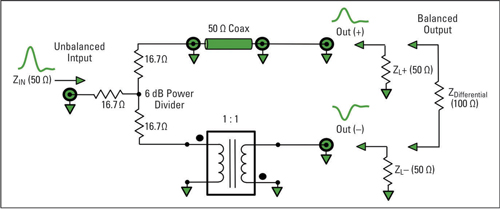 Figure 3. Ultra-wideband balun transformer schematic diagram.
In this version of the design, the in-put signal is split into two identical signals by the 6 dB power divider. One of these signals is then inverted (180-degree phase shift) by the 1:1 inverting transformer. The other signal is sent through a coax cable whose length is chosen to match the propagation delay time of the 1:1 inverting transformer. The input impedance is
50 Ω
. The out-put impedances of both the (+) and (-) coaxial outputs are also 50
Ω
. The differential output impedance is thus 100
Ω
. The 1:1 inverting transformer is a specialty design (sometimes referred to as a pulse inverter) that is a hybrid of coax cable and conventional transformer designs. This design concept results in 1:1 inverting transformers with more than six decades of bandwidth. The major limitation in this balun design is the 3 dB of loss suffered in the 6 dB power divider and that the impedance transformation is limited to 2:1 (i.e., 100
Ω
differential output to 50
Ω
single-ended input).
Differential S-parameter measurements using a single-ended 2-port VNA and a pair of ultra-broadband baluns are compared against measurements taken on a 4-port VNA. The device under test (DUT) is a broadband differential amplifier. The following portion of this article builds on prior work reported in an application note AN-21.
1 The referenced application note demonstrated differential S-parameter measurements to 10 GHz using broadband baluns. Utilizing the industry’s higher bandwidth baluns, the same technique is shown to yield accurate differential S-parameter measurements to 40 GHz and beyond from a single-ended 2-port network analyzer.
2-Port VNA Measurement System
Starting with a 2-port VNA, begin with a typical setup external to the VNA to create a new calibration reference plane. A block diagram of the 2-port to 4-port measurement system is shown in
Figure 4 (the VNA is an Anritsu MS4644B and the baluns are HYPERLABS HL9407). These baluns feature -3 dB bandwidth from 500 kHz to 67 GHz and have excellent phase and amplitude matching at the balanced port. To improve the impedance match of the differential test ports, 10 dB attenuators (HYPERLABS HL9427-10) are added to each of the four differential test ports.
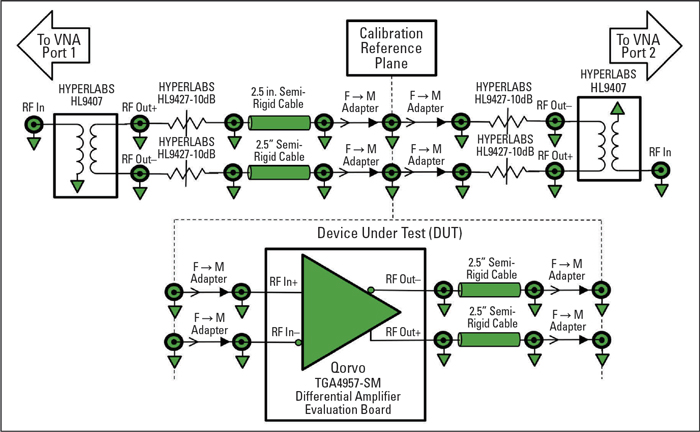 Figure 4. Block diagram of 2-port VNA measurement system utilizing two baluns.
 As shown in Figure 4, the 2-port VNA measurement system was constructed with a male differential test port 1 and a female differential test port 2. This arrangement facilitates zero-length thru calibration of the VNA. The ports of the DUT were configured female-male accordingly for easy insertion. The connector spacing of the differential amplifier evaluation board does not match the connector spacing of the balun, so it was necessary to use interface cables. Short semi-rigid VNA loops were employed to interface the incompatible connector spacings. One set of cables was incorporated into test port 1, and the other set of cables became part of the DUT.
2-Port VNA Calibration
A 12-Term SOLT calibration was performed including isolation using two Anritsu 3652 “K” calibration kits. Each kit contains one female open, one female short, one male open, and one male short calibration standard. Using two kits, it was possible to simultaneously connect two female calibration standards to differential port 1 for each set of Short, Open, and Load reflection calibration.
Figure 5 shows two female and two male open calibration standards, connected to differential test port 1 and differential port 2, respectively. The calibration of port 1 and port 2 was completed simultaneously by cycling through the Short, Open, and Load reflection calibration standards. This approach eliminated the need to swap out equi-phase test port adapters during calibration.
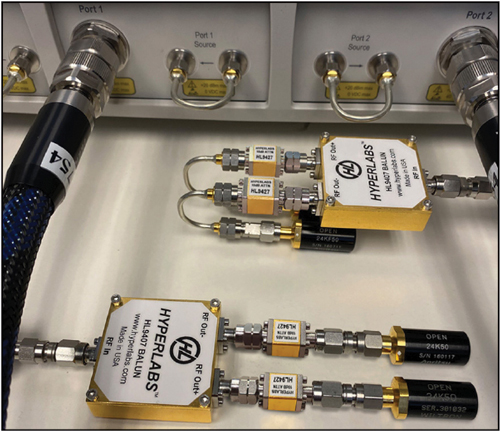 Figure 5. Open reflection calibration of port 1.
 Only one calibration kit’s coefficients could be loaded into the MS4644B VNA. A small calibration error results from minor differences between the two calibration kits.
The quality of the resulting calibration is shown in Figure 6, the active 2-port differential measurement is shown in Figure 7, and the defined DUT is shown in Figure 8.
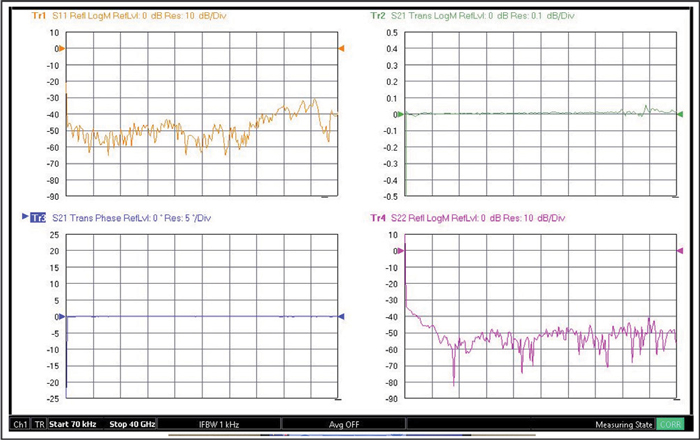
Figure 6. Thru verification of differential calibration.
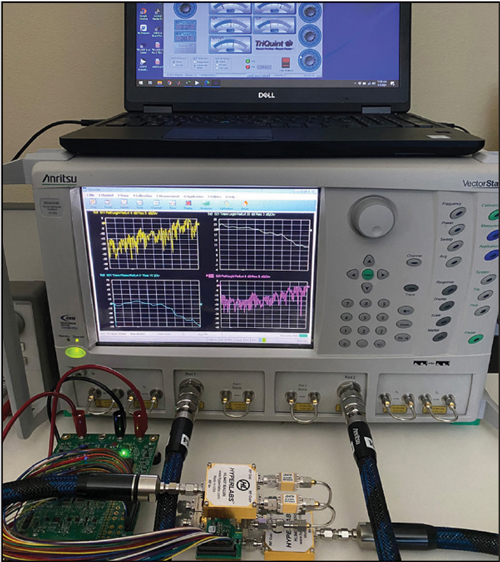
Figure 7. Active 2-port differential measurement.
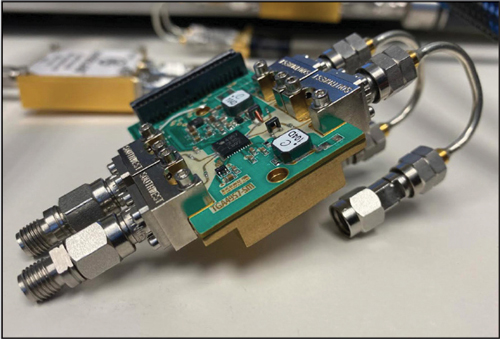 Figure 8. Defined DUT.
4-Port VNA Calibration and Measurement System
A block diagram of the 4-port measurement system is shown in
Figure 9. The VNA is Anritsu MS4647B with MN4697C Multi-Port Test Set. Calibrations were performed using Anritsu 36585V- 2F Precision AutoCal.
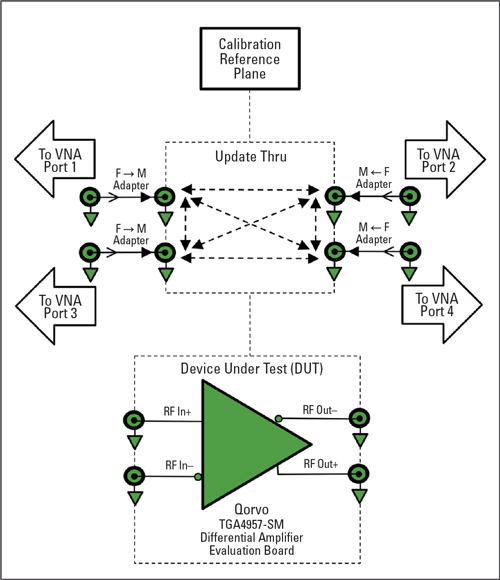 Figure 9. Block diagram of 4-port VNA measurement system.
After completing AutoCal, a Thru Up-date was performed for all port combinations shown in Figure 9 using Anritsu 33VFVF50C female-female adapter (23.62 mm). The delay of the 23.62 mm adapter was entered as a calibration coefficient and corrected by the Thru Update operation. However, the slight attenuation of the adapter was not corrected. As a result, insertion gain measurements taken on the 4-port VNA measurement system are slightly optimistic.
S-Parameter Test Results Measurements obtained from both test systems are compared in Figure 10. The red traces represent data collected on the 4-port VNA measurement system, and the blue traces represent data collected on the 2-port VNA system using HL9407 baluns.
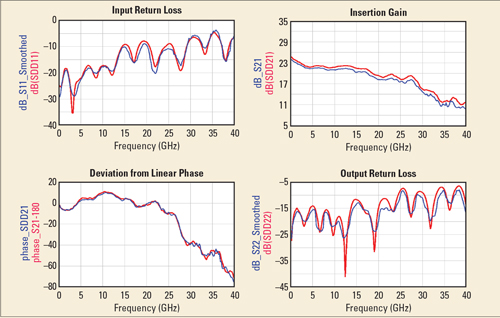 Figure 10. Measured differential S-parameters (4-port VNA in red; 2-port VNA, baluns, and attenuators in blue).
 The return loss data from the 2-port system is noisy and was smoothed with a 4.5% moving average in the plots of Figure 10. The raw data is presented in Figure 11. Port 1 return loss data is noisier than port 2, which may be related to the semi-rigid cables that were integrated into port 1 of the calibrated measurement system. The cables may have deformed due to torquing and flexing after calibration.
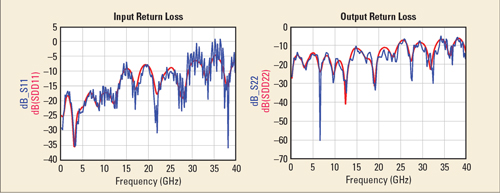 Figure 11. Comparison of raw return loss data.
 The S21 gain response measured with the 4-port measurements system is notably higher than S21 measured on the 2-port measurement system. This can be attributed to two factors. First, the 4-port measurement system was used to characterize a DUT that did not include any coaxial adapters nor cables. In contrast, the 2-port measurements system was used to characterize a DUT that included adapters and cables. Second, as previously mentioned, the Thru Update used during calibration of the 4-port measurement system did not account for insertion loss of the Anritsu 33VFVF50C female-female adapter. These two factors explain the discrepancy in measured S21 response.
Conclusion
This article demonstrates accurate differential S-parameter measurements obtained from a single-ended 2-port VNA using ultra-broadband baluns and attenuators. This measurement system is a cost-effective alternative to purchasing a multi-port test set for a VNA. It is worthy of note that the differential S-parameters reported in this article are only a subset of the full mixed mode S-parameters that were obtained from the 4-port measurement system. The 4-port measurements system does yield common mode and mode conversion S-parameters in addition to differential S-parameters.
REFERENCE
1. J. R. Andrews,
“Differential VNA Measurements Using Single-Ended, Two Port Instruments and BALUNs,” Picosecond Pulse Labs Application Note, AN-21, Dec. 2008.