
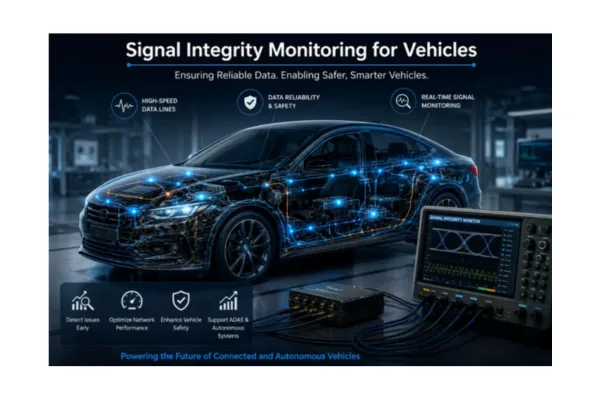
According to Growth Market Report, the global Signal Integrity Monitoring for Vehicles market size reached USD 2.00 billion in 2025, driven by rapid advancements in automotive electronics and the increasing complexity of vehicle communication networks. The market is expanding at a robust CAGR of 9.2 percent and is forecasted to attain USD 4.37 billion by 2034. This growth is primarily propelled by the proliferation of advanced driver-assistance systems (ADAS), widespread vehicle electrification, and the integration of sophisticated infotainment and connectivity features in modern vehicles. The demand for reliable, high-speed data transmission, and the need to minimize signal degradation are critical factors fostering the adoption of signal integrity monitoring solutions across the automotive sector globally.
Introduction
The Signal Integrity Monitoring for Vehicles Market is emerging as one of the most important segments within the automotive electronics ecosystem. As vehicles evolve into software-defined, highly connected, and autonomous mobility platforms, the quality of electronic communication has become just as important as mechanical performance. Every modern vehicle relies on thousands of electrical signals traveling through complex wiring harnesses, sensors, controllers, communication buses, and semiconductor devices. Even a minor signal disruption can affect vehicle safety, performance, and user experience.
Signal integrity monitoring refers to the continuous analysis of electronic signals to ensure they maintain their strength, timing, and accuracy while traveling across various vehicle communication networks. These monitoring solutions detect signal degradation, electromagnetic interference, timing errors, voltage fluctuations, and transmission inconsistencies before they impact critical vehicle operations. As automotive architectures become increasingly data-intensive, signal integrity monitoring is transforming from a design-stage requirement into a real-time operational capability that supports intelligent diagnostics, predictive maintenance, and enhanced vehicle reliability.
What Is Signal Integrity Monitoring in Vehicles?
Signal integrity monitoring is the process of evaluating the quality of electrical signals transmitted between various electronic systems inside a vehicle. Modern automobiles contain hundreds of interconnected electronic control units (ECUs) communicating through high-speed interfaces such as CAN, LIN, FlexRay, Automotive Ethernet, PCIe, USB, and SerDes links.
The objective is to ensure that digital information reaches its destination without distortion, excessive noise, timing errors, or data corruption. Monitoring systems continuously analyze waveform characteristics, jitter, attenuation, crosstalk, impedance mismatches, and electromagnetic disturbances to identify abnormalities before they lead to system failures.
In connected and autonomous vehicles, where millions of data packets are exchanged every second, maintaining signal integrity is essential for dependable decision-making and safe vehicle operation.
Why Is the Signal Integrity Monitoring for Vehicles Market Growing?
Several technological transformations are accelerating market growth. Vehicles now incorporate advanced driver assistance systems (ADAS), high-resolution cameras, radar sensors, LiDAR, infotainment systems, vehicle-to-everything (V2X) communication, over-the-air software updates, and centralized computing platforms. These innovations significantly increase the volume and speed of electronic communication.
Higher data transmission rates leave less tolerance for signal degradation. Automotive manufacturers therefore require advanced monitoring technologies capable of detecting communication errors before they affect system performance. The increasing adoption of electric vehicles (EVs), software-defined vehicles, and autonomous driving technologies further reinforces the need for continuous signal validation across complex electronic networks.
Growing consumer expectations for reliability, stricter functional safety standards, and the expansion of intelligent mobility infrastructure continue to strengthen market demand worldwide
Key Market Drivers
Increasing Electronic Complexity in Modern Vehicles
Today's vehicles integrate hundreds of sensors and numerous ECUs responsible for powertrain management, battery control, safety functions, navigation, connectivity, and autonomous driving. As electronic complexity increases, maintaining reliable communication becomes a major engineering challenge. Signal integrity monitoring enables manufacturers to identify hidden communication issues before they develop into operational failures.
Rapid Expansion of Electric Vehicles
EVs introduce high-voltage systems, battery management electronics, charging controllers, and power conversion modules that generate significant electromagnetic activity. These environments require sophisticated monitoring solutions capable of identifying signal disturbances that could affect charging performance, battery safety, or energy management.
Growth of Autonomous Driving Technologies
Autonomous driving systems depend on uninterrupted communication between cameras, radar, LiDAR, ultrasonic sensors, central processors, and braking systems. Even slight signal distortions may compromise perception accuracy or decision-making. Signal integrity monitoring provides continuous verification that critical communication channels remain reliable throughout vehicle operation.
Automotive Ethernet Adoption
The automotive industry is rapidly replacing conventional communication buses with high-speed Automotive Ethernet to support data-intensive applications. Gigabit communication increases sensitivity to signal quality, making advanced integrity monitoring an essential component of next-generation vehicle architectures.
Predictive Maintenance Capabilities
Modern monitoring platforms use AI and machine learning to recognize communication anomalies before they become failures. This predictive capability reduces repair costs, minimizes unexpected downtime, and improves long-term vehicle reliability.
Emerging Market Trends
Artificial Intelligence Enhancing Signal Diagnostics
AI is enabling monitoring platforms to distinguish between temporary communication disturbances and genuine hardware failures. Intelligent algorithms continuously analyze historical signal behavior, identify recurring patterns, and recommend preventive maintenance before failures occur.
Real-Time Vehicle Health Monitoring
Rather than relying solely on laboratory testing, manufacturers are integrating real-time monitoring directly into production vehicles. This allows continuous observation of communication quality throughout the vehicle lifecycle, enabling faster diagnostics and improved fleet management.
Integration with Digital Twins
Digital twin technology allows engineers to create virtual representations of vehicle electronic systems. Signal integrity monitoring data continuously updates these models, helping manufacturers simulate future performance, optimize designs, and predict failures with greater accuracy.
Edge Computing Applications
Instead of transmitting all diagnostic information to cloud servers, edge computing enables local analysis within the vehicle. This reduces latency while providing immediate responses to communication abnormalities that may affect critical driving functions.
Cybersecurity Convergence
Cybersecurity and signal integrity are becoming increasingly interconnected. Unexpected communication behavior may indicate hardware degradation, electromagnetic interference, or potential cyberattacks. Future monitoring platforms increasingly combine signal diagnostics with cybersecurity intelligence to improve overall vehicle resilience.
Market Challenges
Despite its strong growth prospects, the market faces several technical and commercial challenges. High implementation costs remain a concern, particularly for entry-level vehicle segments where manufacturers must carefully balance performance with affordability.
The increasing diversity of communication protocols also creates integration complexity. Vehicles often combine legacy networks with next-generation high-speed interfaces, requiring monitoring systems capable of supporting multiple communication standards simultaneously.
Another challenge involves the shortage of engineers specializing in high-speed signal analysis, electromagnetic compatibility, and advanced automotive electronics. As vehicle architectures become increasingly sophisticated, organizations require multidisciplinary expertise spanning hardware, software, and communication engineering.
Additionally, enormous volumes of diagnostic data generated by continuous monitoring require efficient processing, storage, and analysis without increasing computational overhead or power consumption.
Opportunities Transforming the Industry
Future opportunities extend far beyond traditional vehicle diagnostics. Connected vehicle ecosystems, intelligent transportation infrastructure, autonomous commercial fleets, and mobility-as-a-service platforms all depend on highly reliable electronic communication.
Fleet operators can leverage continuous signal monitoring to reduce maintenance costs and maximize vehicle availability. Insurance companies may utilize communication health metrics to improve risk assessment, while automotive manufacturers can analyze anonymized fleet-wide signal data to enhance future product development.
The growing deployment of over-the-air software updates creates another significant opportunity. Monitoring systems can verify communication stability before, during, and after software deployment, reducing update failures and improving customer satisfaction.
Vehicle manufacturers are also exploring cloud-connected diagnostic ecosystems where real-time signal health data contributes to predictive analytics across millions of connected vehicles.
Competitive Landscape
- Analog Devices, Inc.
- Texas Instruments Incorporated
- NXP Semiconductors N.V.
- Infineon Technologies AG
- STMicroelectronics N.V.
- onsemi (ON Semiconductor Corporation)
- Renesas Electronics Corporation
- Rohde & Schwarz GmbH & Co KG
- Tektronix, Inc. (Fortive Corporation)
- Keysight Technologies, Inc.
- Anritsu Corporation
- Microchip Technology Inc.
- Marvell Technology Group Ltd.
- Broadcom Inc.
- Cadence Design Systems, Inc.
- Teledyne LeCroy
- Yokogawa Electric Corporation
- Samtec, Inc.
- Vector Informatik GmbH
- Synopsys, Inc.
Future Outlook
According to Growth Market Report, the future of the Signal Integrity Monitoring for Vehicles Market will be shaped by the increasing digitalization of mobility. Vehicles are rapidly becoming intelligent computing platforms where electronic communication forms the foundation of every critical function. As autonomous driving, vehicle connectivity, electrification, and software-defined architectures continue to advance, maintaining flawless signal transmission will become indispensable.
Next-generation monitoring systems will evolve from passive diagnostic tools into intelligent decision-support platforms capable of predicting failures, optimizing network performance, supporting autonomous operations, and enabling self-healing electronic architectures. AI, machine learning, edge computing, and cloud analytics will work together to provide continuous visibility into vehicle communication health throughout the product lifecycle.
Manufacturers that invest in advanced signal integrity technologies today will be better positioned to deliver safer, more reliable, and future-ready vehicles for increasingly connected transportation ecosystems.