

A dominant theme at DesignCon 2026 was the shift from traditional device-level design toward system-level architectures optimized for AI workloads. The industry is increasingly focused on solving complex challenges in AI data center infrastructure, including networking bandwidth, thermal management, and power delivery across the entire hardware stack — from die to rack. Several companies showcased emerging interconnect solutions like 448 G and 1.6 T link technologies, reflecting a race to overcome signal integrity and physical limits imposed by extreme speeds. DesignCon 2026 emphasized connectivity spanning from chip packaging up through rack and data center infrastructure — not just board-level designs. DesignCon also featured a robust technical program, including 100+ educational sessions and panels on topics like signal/power integrity, EDA techniques, and AI-optimized design methodologies, with keynote talks from industry leaders.
Here is a link to our DesignCon 2026 videos and photo gallery. Below is a summary of what some companies had on display:
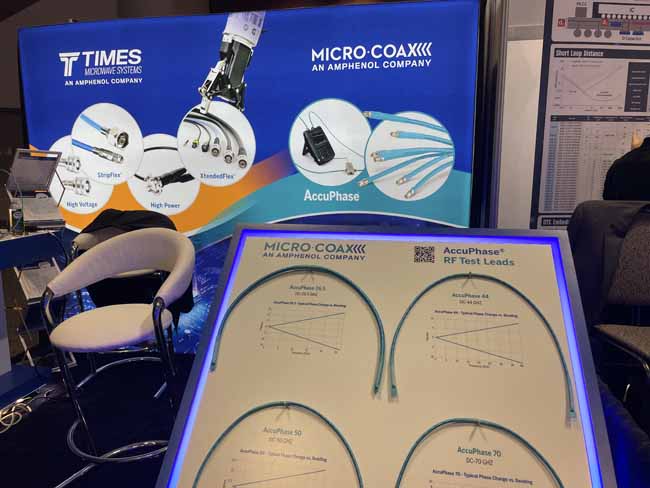 Amphenol - Micro-Coax launched AccuPhase™, providing customers with enhanced access to its cutting-edge, mission-critical cable and connectivity solutions. The AccuPhase line is a new family of high-stability RF test assemblies engineered for precise, repeatable measurements in laboratory, production, and flight line environments. Designed to connect test equipment to RF components without requiring recalibration after movement, AccuPhase products deliver excellent phase and insertion loss stability, shielding effectiveness, and durability across frequencies up to 70 GHz. AccuPhase test assemblies address a persistent challenge in RF testing environments, where traditional armored test cables are often too large, too heavy, or too rigid for modern, high-density setups. By combining internal ruggedization with a flexible coaxial construction, AccuPhase test leads enable reliable connections that maintain measurement integrity even under repeated flexure, temperature variation, and extended use.
Amphenol – Times Microwave Systems announced the expansion of its XtendedFlex™ product family with six ultra-flexible micro-coaxial cable options: XtendedFlex 045, 142, 174, 178, 213, and 304. Designed to support demanding applications where flexibility, reliability, and signal integrity are critical, the XtendedFlex family delivers consistent RF performance in dynamic, space-constrained environments. Built on a common design philosophy, XtendedFlex cables are engineered to withstand repeated motion and tight bend radii without compromising electrical or mechanical performance. The expanded family enables engineers to scale designs across multiple cable diameters while maintaining predictable attenuation, RF shielding, impedance control, and durability. This makes the XtendedFlex line well suited for applications ranging from medical devices and industrial automation to aerospace, instrumentation, and advanced electronics.
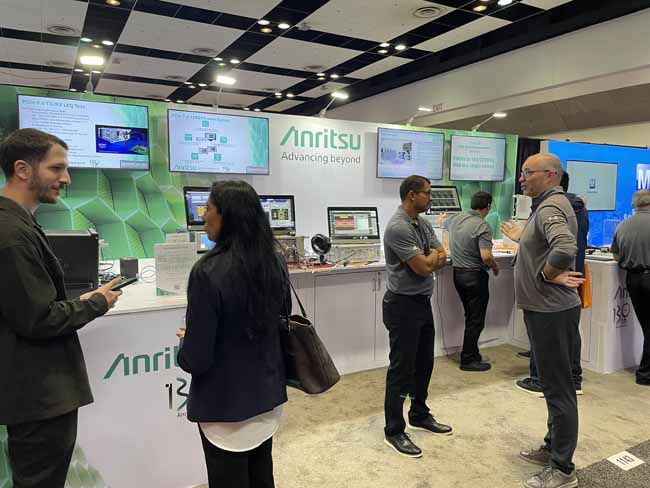 Anritsu Company, in collaboration with Tektronix, Teledyne LeCroy, and SiPhx, conducted live demonstrations, including two on PCI-Express® 6.0 (PCIe® 6.0) and PCI-Express® 7.0 (PCIe® 7.0). Other demonstrations in the Anritsu booth will include 448G interconnect development and broadband S-parameter characterization. The demonstrations highlighted testing emerging technologies, including: Anritsu teamed with SiPhx, a leading supplier of optical transceivers, to demonstrate PCIe 7.0 over optics. The demos featured the Anritsu Signal Quality Analyzer-R MP1900A to transmit 64 Gbaud PAM4 signals, as well as the SiPhx 800G LPO Optical Module and 128GT/s TDECQ measurements with Anritsu’s BERTWave™ MP2110A Sampling Oscilloscope. Additionally, Anritsu used the Tektronix DPO70000SX ATI Performance Oscilloscope to showcase key transmitter electrical measurements, such as SNDR and RLM at 128 GT/s. Further highlighting its PCIe testing support, Anritsu demonstrated stable PCIe 6.0 Link Training and BER measurements using an add-in card. The demonstration, which was done in collaboration with Teledyne LeCroy, highlighted the capabilities of the MP1900A. In partnership with Foxconn Interconnect Technology Ltd. (FIT), Anritsu supported next-generation 448G twinax cable development using its VectorStar™ ME7838AX 125 GHz broadband VNA, enabling high-accuracy characterization of advanced high-speed interconnects.
 Cadence showed off innovations in PCB, IC package, IP, and system-level design in their booth. They showed how to tackle today’s toughest challenges, including:
- Signal, power, thermal, and electromagnetic analysis
- Chiplets, 3D ICs, and advanced interconnects
- GPU-accelerated simulation
- PCB and IC package in-design analysis
- Advanced IP solutions for AI factories
They also had Sponsored Sessions and Panels covering next-gen IC packaging, AI-driven thermal optimization, high-speed memory for AI data centers, and power and signal integrity innovation and Networking Event, “No Illusions. Just Experts” including food, drinks, prizes, and real conversations with Cadence and industry experts.
Foxconn Interconnect Technology (FIT) made its debut at DesignCon displaying the following:
- 1.6T High-Speed Interconnects: Engineered for next-generation AI architectures, providing ultra-high-density bandwidth to satisfy extreme instantaneous data transfer requirements.
- Next-Gen CHIPLINK® 448G Solutions: Specifically designed to address the escalating signal integrity, high density, and mechanical integration challenges of 224G and 448G AI/HPC systems. The CHIPLINK® CPC (Cabled Protein Card) architecture utilizes a socketed modular wafer design supporting 30–34 AWG cabling, offering flexible scaling for CPC-to-I/O, CPC-to-CPC, and CPC-to-Backplane topologies. This solution optimizes high-density differential pair routing while significantly improving insertion loss (IL) and crosstalk performance.
- Advanced Liquid Cooling: Superior thermal management performance tailored for hyperscale data centers and AI clusters to combat the heat challenges of rising compute density.
- PCIe® 6.0 / 7.0 Cabling Solutions: High-performance, low-latency expansion options that optimize connectivity efficiency for AI computing resources.
- RF Waveguide Interconnects: Developed in collaboration with Point2 Technology, these cutting-edge high-frequency solutions offer an alternative to traditional copper and fiber, effectively addressing power consumption, reach, and integration hurdles at extreme data rates.
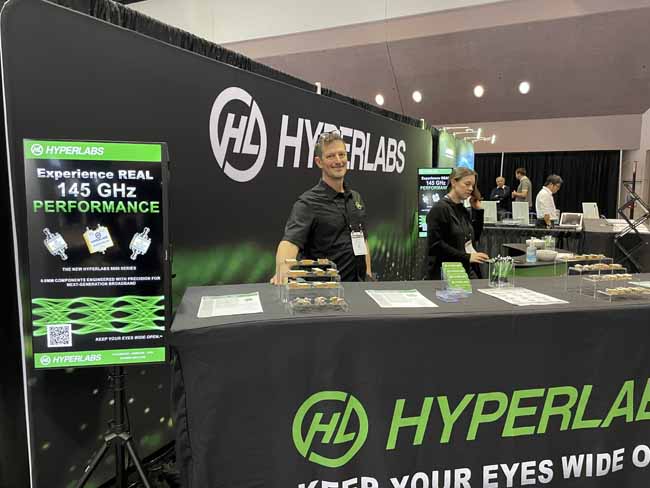 HyperLabs was displaying the world’s first 0.8 mm components designed specifically with 145 GHz and 224 Gbps PAM4 applications in mind. Attenuators and DC Blocks are available in Q1 2026, with baluns to follow in Q2. The HL8828 is an ultra-broadband attenuator with a typical fixed insertion loss of 6 dB with a very flat frequency response from DC to 145 GHz. The HL8838 is an ultra-broadband DC Block with a typical insertion loss of < 3 dB over an industry-best bandwidth of 16 kHz to 145GHz. The HL8808 is an ultra-broadband 180° signal splitter and combiner that offers excellent amplitude and phase match over an industry-best bandwidth of 500 kHz to 115 GHz (3 dB), with usable bandwidth to 145 GHz (12 dB).
Data rates keep increasing; make sure your test system can keep up. Our ultra-broadband devices pass clean eyes with minimal signal perturbation, preserving the performance of the high-speed designs you worked so hard to create.
Junkosha announced the launch of their latest Microwave/mmWave Coaxial Cable Assemblies at this year’s DesignCon, engineered to support ultra high-speed signal transmission up 110 GHz and 120 GHz with skew matched to 0.5 psec. The MWX001 and MWX002 cables address the quest for ever faster data transfer speeds for next-generation high-speed digital systems, including data center communication and precision test environments. In addition to this debut, Junkosha’s MWX0A5, the first 0.5 mm connector cable capable of transmitting signals from DC to 250 GHz, will be on display.
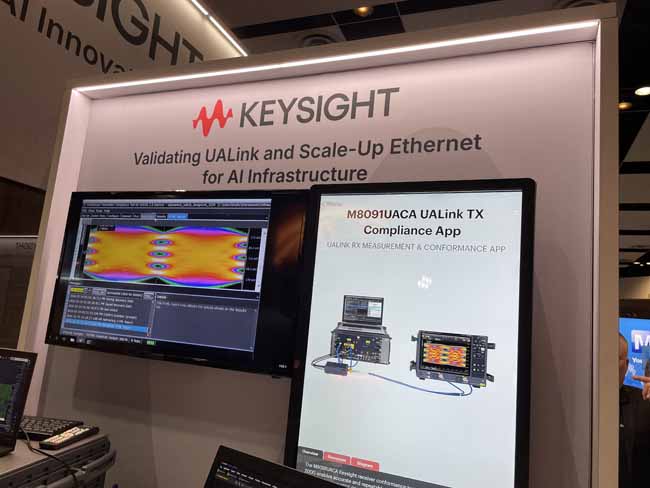 Keysight introduced 3D Interconnect Designer, a new addition to its Electronic Design Automation (EDA) portfolio. The solution addresses the mounting complexity of designing 3D interconnects for high-chiplet and 3DIC advanced packages used in AI infrastructure and data center applications. They also announced a new graphics double data rate 7 (GDDR7) transmitter compliance solution, which accelerates validation of Joint Electron Device Engineering Council (JEDEC) standards for graphics and AI applications. The Keysight GGDR7 transmitter test solution consists of D9370GDDC software that runs on Keysight's UXR oscilloscope series and automates debug and characterisation of GDDR7 transmitter designs to ensure compliance with JEDEC JESD239 specifications. When paired with the InfiniiMax Ultra Probe Amplifier, 25 GHz Probe, the solution enables accurate PAM3 signal analysis and timing measurements, allowing engineers to validate and optimise high-speed memory transmitter designs for next-generation GPUs and memory devices. Keysight launched its next-generation Infiniium XR8 Real-Time oscilloscopes, designed to accelerate high-speed digital and compliance testing while improving efficiency and insight for modern electronics development. The Infiniium XR8 addresses SI/PI challenges with a completely new hardware and software architecture optimized for today’s high-speed digital applications and emerging standards, helping engineering teams condense days of testing into hours.
Marki Microwave was showing their Passive glass RF filters that are high-performance components that leverage glass substrates to provide superior signal integrity, low insertion loss, and extreme miniaturization compared to traditional PCB or ceramic-based filters. They offer high-performance in a small footprint and offer an online tool for filter specification.
MathWorks participated in a hands‑on AI for engineering applications bootcamp running on the latest small‑model LLMs. They gave an opportunity for attendees to build their own SI/PI Agent in MATLAB with a few simple steps. Agentic AI is becoming a powerful tool with simulation tools like MATLAD. On Wednesday, they presented a joint paper with Intel and Simbeor on Multi-Agent AI Systems for Autonomous Signal Integrity Analysis of PCB & Package Designs.
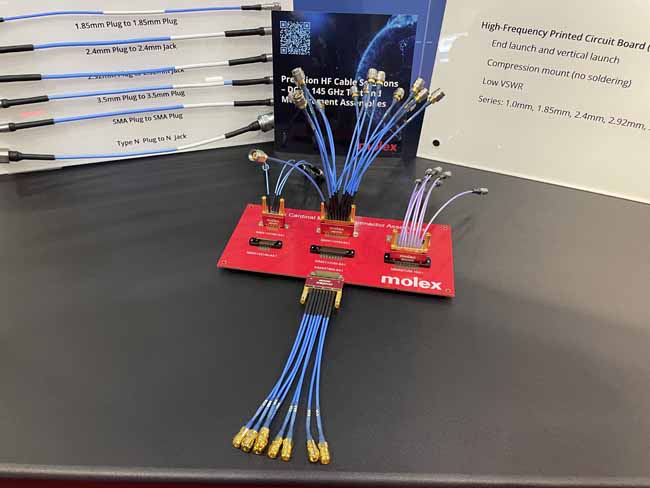 Molex announced the Cardinal Multi-Port High-Frequency Coaxial Assemblies, extending the proven Cardinal family into the high-bandwidth spectrum demanded by next-generation AI architectures and 6G wireless infrastructure. The solution supports frequencies up to 145 GHz and data characterization rates up to 448 Gbps. As 6G research and AI backhaul push beyond 110 GHz, the new Cardinal assemblies can handle signals previously out of reach for standard coaxial interfaces. The result: engineers can validate the silicon and networking protocols that will define the next decade of global connectivity—without changing platforms. Molex recently announced the availability of Impress Co-Packaged Copper Solutions to meet the needs of hyperscale data centers and AI workflows. As the next leap in architecture evolution, Impress builds on Molex’s success with NearStack On-the-Substrate (OTS) Connectors, which pave the way with more than a million units delivered to date. A versatile, two-piece connector system, Impress delivers ultra-high-speed data transmission and exceptional signal integrity, providing a full-channel solution with complete isolation from the substrate to the interconnect. Supporting data rates up to 224Gbps PAM-4 and beyond, Impress joins Molex’s robust 224G product portfolio, including Mirror Mezz™ Enhanced, Inception™ and CX2 Dual Speed, to meet explosive growth in high-speed data transmissions.
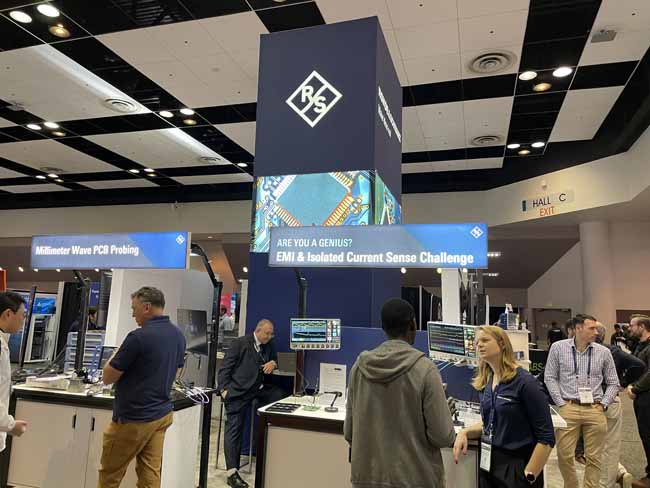 Rohde & Schwarz had live demonstrations spanning power integrity, optical testing, high-frequency probing, and multi-channel compliance. Below are highlights:
- Millimeter Wave PCB Probing – R&S ZNA with frequency extension enables high-frequency S-parameter measurements on PCB structures for 5G, 6G, and advanced packaging applications.
- IEEE 802.3dj Compliance Testing – A 48-channel VNA configuration using the R&S ZNA and R&S OSP switch platforms for next-generation 200 Gb/s per lane Ethernet cable compliance testing.
- Load Step Response Testing – Real-time PDN validation using the MXO 5 oscilloscope paired with Picotest’s industry-leading load stepper technology for power integrity characterization.
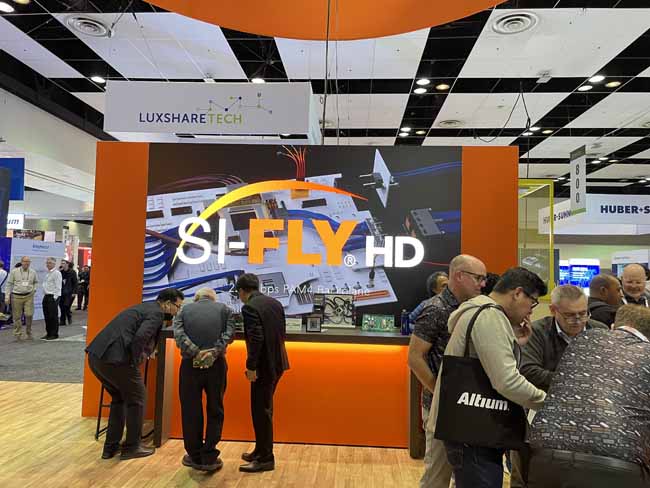 Samtec’s booth included active demonstrations of Si-Fly® HD co-packaged copper (CPC) connectors operating at 224 Gbps using partner silicon, which were introduced last year at DesignCon. This year, Samtec expanded the family with active demonstrations including the new 224 Gbps Si-Fly® backplane system and Flyover® OSFP Cable System. Also notable was an active demonstration of a next-generation Si-Fly HD prototype operating at 448 Gbps (IMG0644).
Smiths Interconnect presented the DaVinci Gen V High-Speed Test Socket, supporting extremely high transfer rates (PAM4 at ~224 Gbps) and designed for next-gen computing and communications platforms.
TE Connectivity has TE 224G portfolio solutions that are a holistic product portfolio consisting of a wide array of products designed with interconnectivity and compatibility in mind – reducing time to market and overall product uncertainty. TE’s robust end-to-end product portfolio touches each part of the datacenter from server to infrastructure – and all devices in between. TE’s continued leadership in industry standards creates a robust ecosystem with design partners. Also they displayed cabled STRADA Whisper that reduces insertion loss for improved channel margin and allows for more creative system architecture design possibilities. These products can support 112 Gbps PAM-4, with future expansion to 56 Gbps NRZ and 112 Gbps PAM-4. Our manufacturing process includes extensive electrical and visual checks at every step to bring you the best quality product possible.
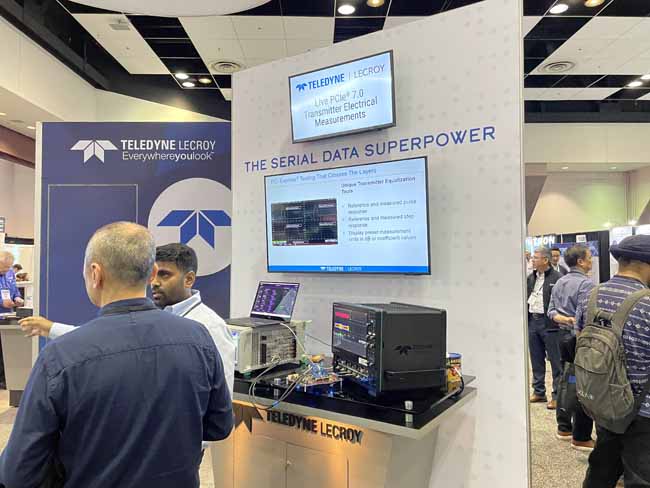 Teledyne LeCroy had 6 demos: Live PCIe 7.0 Transmitter Electrical Measurements that use the SDA 8650HD 65 GHz 12-bit oscilloscope with the Anritsu MP1900A BERT to perform Transmitter electrical measurements on a Synopsys PCIe 7.0 device operating at 128 GT/s. The SDA 8650HD’s industry-leading bandwidth, low-noise front end, and advanced PCIe 7.0 analysis tools enable precise eye, jitter, SNDR, and equalization measurements. IEEE 802.3ck/bs and OIF-CEI 112G/56G Debug and Analysis that features a joint demonstration with Alphawave, highlighting advanced debug and analysis of IEEE 802.3ck/bs and OIF-CEI-112G/56G serial links using SDAX-ENET-50G-100G. This station demonstrates practical workflows for isolating signal integrity issues and analyzing PAM4 signal quality. High-Accuracy DDR5 Decoding and Compliance Testing that shows how Teledyne LeCroy’s DDR Debug Toolkit and QualiPHY 2 automation platform enable seamless transition between JEDEC Compliance Testing, and interactive decoding and eye diagram analysis of a live DDR5 device. Precision S-Parameters and De-embedding that achieves sub-millimeter resolution and precise Z0 profiling for high-speed interconnects and cable assemblies. It showed how WavePulser’ s network analysis and IEEE 370-compliant 2XThru de-embedding reveal true DUT performance by removing fixture effects. Unique DC-coupled TDR-based technology means better visibility into details like reference plane location, enabling more precise de-embedding. USB/Thunderbolt and DisplayPort Compliance and Debug that shows the latest expert analysis and compliance automation tools from Teledyne LeCroy can complete electrical compliance testing more efficiently than ever before, and advanced debug capabilities accelerate both test debug and interoperability validation. And Live PCIe 6.0 Link Training Analysis with CrossSync PHY technology seamlessly merges the functions of a protocol analyzer and oscilloscope – giving insight into link behavior that no other instrument can provide. This joint demonstration with Cadence shows unmatched insight into PCI Express 6.0 link training operation.
Summary of Trends
- AI-first system architectures replacing traditional component-centric design approaches.
- Ultra-high-speed connectivity (PCIe 8.0, 448G, 1.6T) driving new signal integrity and power challenges.
- System-level test and validation tools becoming essential for multi-terabit design confidence.
- Holistic data center solutions (interconnect, power, thermal management) moving to the forefront of hardware design discussions.