

Yole Group announced the release of its new Optical Satellite Communication 2025 report, a detailed exploration of the technologies, markets and industry players shaping the future of optical communication in space. Yole Group’s report analyzes optical terminals, devices, ground systems and the emerging integration of quantum technologies across satellite networks.
With this new report, the market research & strategy consulting company provides a complete understanding of optical communication trends in space, satellite and device architectures and an analysis of technological bottlenecks and performance roadmaps. It also provides comprehensive market forecasts for 2025 to 2030 and presents the supply chain structures and partnerships shaping market expansion.
Eric Mounier, Ph.D., chief analyst at Yole Group said, "Optical satellite communication (OSC) is entering its industrial phase. What was once experimental is now scaling at the constellation level, with thousands of terminals, standardized interfaces and ground networks built for global reach."
Optical SATCOM Accelerates Toward Multi-Billion-Dollar Scale
Between 2024 and 2030, the OSC market will expand rapidly across terminals, devices, ground systems and service applications. This reflects both the industrialization of laser communication technologies and their increasing deployment in large satellite constellations.
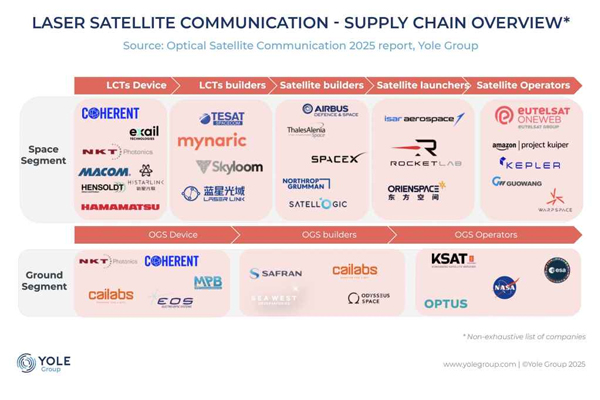
Laser Communication Terminals (LCTs): The Core Growth Engine
In 2024, approximately 4,000 LCTs were already in orbit, with Starlink dominating. However, annual shipments are accelerating sharply as:
- Starlink continues high volume deployments
- Guowang will ramp up after 2026
- Amazon Kuiper is entering with its first units in 2025
- Adoption of merchant terminals is increasing beyond vertically integrated operators.
This surge drives LCT system revenues to US$2.4 billion in 2030, representing a 28% compound annual growth rate (CAGR).
Optical Device Ecosystem: Steep Scaling and Component Innovation
The core device market, including photodetectors, laser sources, modulators, power amplifiers and other ICs, will grow to almost $400 million by 2030, with a 37% CAGR.
Power amplifiers and modulators, essential to high-throughput optical links, capture the largest share of unit shipments and value.
Semiconductor innovation is accelerating with the adoption of:
- Indium Phosphide (InP) and Silicon Nitride Photonic Integrated Circuits combining lasers, modulators, and coherent receivers of >100 Gb/s/wavelength,
- GaN and InP power components to improve efficiency, radiation resilience and thermal stability.
These device advances are foundational for next-generation LEO inter-satellite links.
Technology Roadmap: Toward Interoperable, Quantum-Ready, 100-Gb/s-Class Terminals
Roadmaps across operators, manufacturers, and agencies converge on three priorities:
Throughput Scaling
- LEO–LEO: 2.5 Gb/s (defense) → 200 Gb/s (commercial)
- LEO–Ground: 1–10 Gb/s operational → 200 Gb/s demonstrated
- GEO–Ground: 1.2 Gb/s today → 10 Gb/s by 2030.
Terminals will deliver tens to hundreds of Gb/s per satellite, enabling multi-hundred-Tb/s networks across broadband, IoT, quantum and defense missions.
Standardization and Interoperability
- Standards such as SDA OCT, CCSDS and ESTOL support cross-vendor and cross-operator link compatibility
- Modular optical ground station concepts (MOGS, TILBA) improve network resilience and deployment flexibility
Quantum-Secure and PIC-Enabled Architecture
- Quantum-secure links (e.g., SpeQtral QKD satellites)
- Radiation-hardened fibers and LiNbO₃ modulators
- Integrated PIC platforms (InP, SiN) for >100 Gb/s per wavelength coherent optical systems.
“The OSC roadmap is converging toward high-throughput, interoperable, and quantum-secure systems,” explains Eric Mounier from Yole Group. “Photonic integration and wide-bandgap semiconductors are reshaping terminal performance and redefining what is achievable in space-based communications.”
OSC is transitioning into a global, scalable, multi-billion-dollar industry. As constellations multiply, ground networks densify and optical devices achieve higher integration and quantum-ready performance, the OSC market enters a phase defined by industrialization, standardization and strategic investment. Yole Group encourages industry stakeholders, investors and technology leaders to explore the complete findings of the Optical Satellite Communication 2025 report and on yolegroup.com.