

High-Current Subsystem (EPC7C023) Performance
For the large-die HEMT configuration (EPC7019G), the load current was stepped across virtually its full operating range, spanning from 0.1 A to 5 A. As captured in the hardware test data (see Figure 6), the control loop dampens the step transition within ~50 µs, maintaining a tight peak voltage deviation of only ~160 mV.
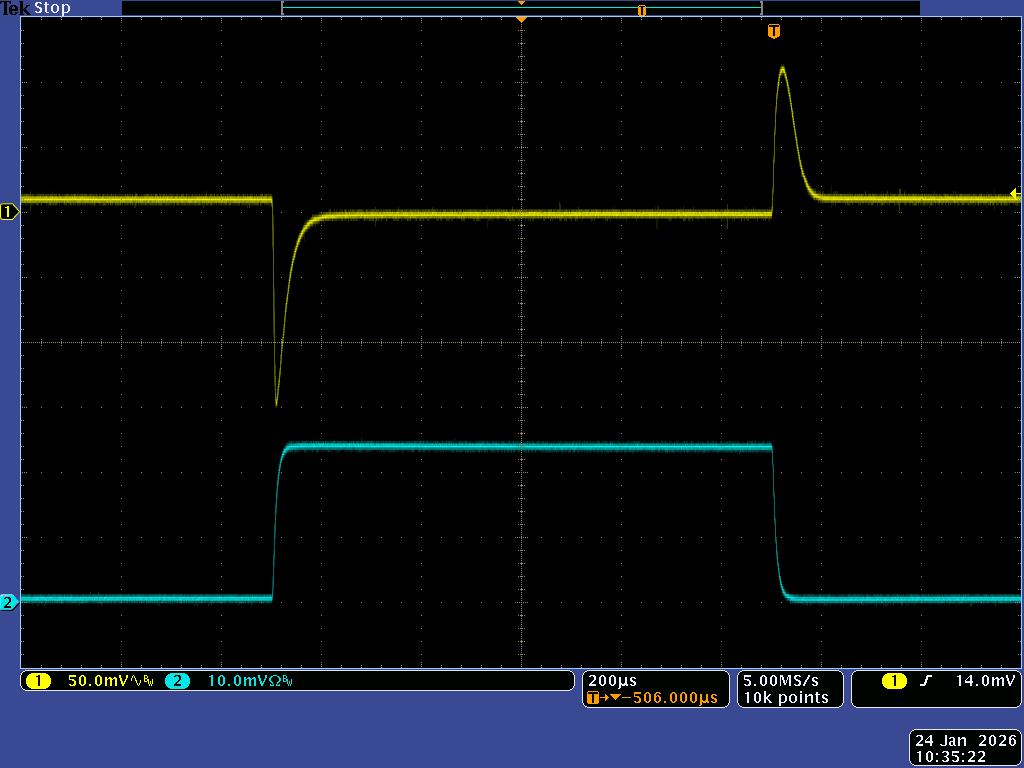
Figure 6: EPC7C023 Current Step-Change Response: 0.1A-to-5A.
Low-Current Subsystem (EPC7C024) Performance
For the smaller-die HEMT variant, the transient load step was verified from 0.05 A to 0.5 A. Driven by a tighter internal parasitic capacitance profile, the voltage loop recovers within ~40 µs, restricting the maximum voltage deviation to a nominal 110 mV (see Figure 7).
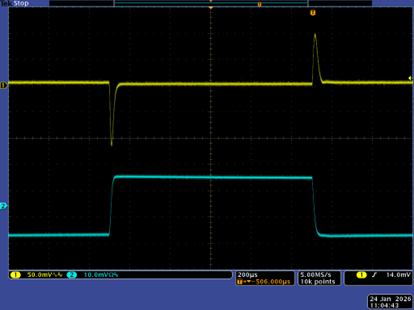
Figure 7: EPC7C024 Current Step-Change Response: 0.05A to 0.5A
Value Proposition & Broadband System-Level Implications
The demonstrated performance of eGaN HEMTs in continuous linear regulation alters high-reliability aerospace design trade-offs. Traditionally, spacecraft power distribution networks require separate semiconductor qualification pipelines for high-frequency payloads and continuous DC regulation. Proving that eGaN technology can operate as a stable, radiation-tolerant LDO pass element enables broad architectural consolidation beyond localized efficiency parameters.
Spectral Versatility: Unifying DC and RF Power Infrastructure
The core architectural benefit highlighted by Tony Marini revolves around the broadband utility of the GaN substrate. While Gallium Nitride has established a definitive role in high-frequency switching power converters and RF power amplifiers, its deployment in zero-frequency (DC) analog applications completes a crucial design continuum.
This spectral versatility yields significant advantages for spaceflight systems:
- Component Qualification Consolidation: Utilizing a single, inherently radiation-hardened semiconductor technology across the DC-to-RF frequency spectrum reduces the overhead associated with establishing diverse component qualification lifecycles.
- Elimination of Radiation Shielding Mass: The structural immunity to TID degradation simplifies structural design. Designers can omit heavy localized spot shielding around linear voltage regulators feeding sensitive payloads.
- System Drift Redundancy Mitigation: Because the physical control nodes do not undergo the radiation-induced charge-trapping typical of silicon-oxide interfaces, the need for complex digital calibration or telemetry compensation networks to correct for rail drift over long mission lifespans is eliminated.
Minimization of Worst-Case Design Margins
Silicon linear regulators require over-designed loops to counter orbital parameter drift. Conversely, the eGaN control loop maintains stable, oscillation-free transient responses without complex compensation because its transconductance thresholds remain unchanged over the spacecraft's operating life. This proves eGaN HEMTs act as reliable continuous DC regulation elements, giving aerospace designers a single, uniform semiconductor platform handling everything from direct current to microwave frequencies.
Implementation Guidelines
The verification of eGaN HEMTs within LDO linear regulator topologies provides a clear framework for high-reliability aerospace power distribution networks. By evaluating the structural boundaries, thermal dynamics, and loop behavior analyzed in the preceding sections, designers can implement unified guidelines to maximize system reliability in hostile orbital environments.
Component Implementation Guidelines
To replicate the deterministic, oscillation-free performance recorded on the evaluation hardware, space-grade system layout execution must adhere to three strict design constraints:
- Gate Drive Impedance and Stray Inductance Control: Due to the high transconductance (gm) of eGaN devices, any parasitic inductance at the gate terminal can couple with the internal capacitances to induce high-frequency ringing. Gate routing traces must be minimized to short, wide geometries, and placed on the same PCB layer as the analog error amplifier whenever possible.
- Dynamic Thermal Layout Decoupling: Linear pass elements operating under constant input-to-output voltage differentials face continuous thermal dissipation (PD = ΔV . Iout). Designers must maximize the use of planar ceramic helper pads (such as aluminum nitride structures) to route heat laterally into internal board copper planes, preventing localized hot spots from shifting the operating thresholds of surrounding low-voltage reference circuits.
- External Sense Resistor Placement: To preserve the native, uncompensated dropout voltage performance of the GaN substrate, the current sense resistor must remain physically outside the closed voltage feedback loop. However, designers must account for its continuous series ohmic loss when calculating the total worst-case dropout ceiling at the system level.
Conclusions
Integrating eGaN HEMTs into linear regulation architectures successfully bridges a critical gap in spacecraft power infrastructure. This architecture demonstrates that Gallium Nitride is no longer restricted to high-frequency switching converters or RF payloads; it can operate as a reliable, stable pass element for continuous DC regulation.
Ultimately, this structural validation allows aerospace engineers to implement a single, unified semiconductor platform across the entire DC-to-RF frequency spectrum. Consolidating the component procurement lifecycle, eliminating local radiation shielding mass, and removing end-of-life parameter drift margins allow for the development of lighter, more efficient, and highly ruggedized power electronics optimized for deep-space and long-duration orbital missions.